


Page 120 - 南京医科大学自然版
P. 120
第46卷第11期
               ·1706 ·                           南 京    医 科 大 学 学         报                        2026年11月


                                               表1 标准化仿生胫骨的生物力学特性
                                  Table 1 The biomechanical properties of standardized biomimetic tibias

                   Vriable            Simulatedcortical bone(short fiber filled epoxy)  Simulatedcancellous bone(rigid polyurethane foam)
               Density                             1.64 g/cc                            0.27 g/cc
               Compressive    Strength             157.0 MPa                            6.0 MPa
                              Modulus              16.7 GPa                             155.0 MPa
               Longitudinal tensile Strength       106.0 MPa                               /
                              Modulus              16.0 GPa                                /
               Transverse tensile  Strength        93.0 MPa                                /
                              Modulus              10.0 GPa                                /
                 /:not available.


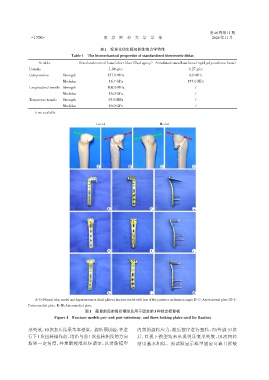
                                             Lateral                       Medial


                                              A              B             C              D


                                                   E                  F                   G


                                                   H                   I                  J


                                                   K                  L                   M
                 A-D:Normal tibia model and hyperextension tibial plateau fracture model with loss of the posterior inclination angle. E-G:Anterolateral plate. H-J:
              Posteromedial plate. K-M:Anteromedial plate.
                                        图1 截骨前后的骨折模型及用于固定的3种锁定接骨板
                          Figure 1 Fracture models pre⁃ and post⁃osteotomy,and three locking plates used for fixation

              形失效,10次加压结果基本相似。旋转预试验:在进                          内部的旋转应力,随后按序进行扭转,内/外旋10次
              行下1次扭转操作前,均沿与前1次扭转相反的方向                           后,直视下模型均未出现明显变形失效,10 次扭转
              旋转一定角度,并重新校准扭矩调零,以消除模型                            结果基本相似。预试验显示模型固定可靠且拆装

