


Page 140 - 南京医科大学自然版
P. 140
第46卷第11期
               ·1726 ·                           南 京    医 科 大 学 学         报                        2026年11月


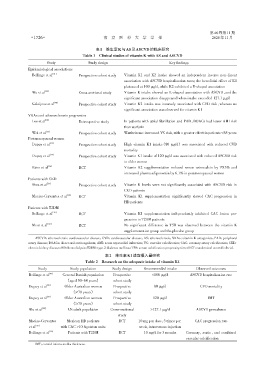
                                             表1 维生素K与AS及ASCVD的临床研究
                                       Table 1 Clinical studies of vitamin K with AS and ASCVD

                       Study              Study design                         Key findings
              Epidemiological associations
                Bellinge et al [41]  Prospective cohort study  Vitamin K1 and K2 intake showed an independent inverse non⁃linear
                                                          association with ASCVD hospitalization rates; the beneficial effect of K1
                                                          plateaued at 100 μg/d,while K2 exhibited a U⁃shaped association
                Wu et al [44]        Cross⁃sectional study  Vitamin K intake showed an L⁃shaped association with ASCVD,and the
                                                          significant association disappeared when intake exceeded 127.1 μg/d
                          [48]
                Geleijnse et al      Prospective cohort study  Vitamin K2 intake was inversely associated with CVD risk,whereas no
                                                          significant association was observed for vitamin K1
              VKAs and atherosclerosis progression
                      [54]
                Lee et al            Retrospective study  In patients with atrial fibrillation and PAD,DOACs had lower AMI risk
                                                          than warfarin
                Wei et al [55]       Prospective cohort study  Warfarin use increased VC risk,with a greater effect in patients <65 years
              Postmenopausal women
                        [52]
                Dupuy et al          Prospective cohort study  High vitamin K1 intake(80 μg/d)was associated with reduced CVD
                                                          mortality
                Dupuy et al [53]     Prospective cohort study  Vitamin K1 intake of 120 μg/d was associated with reduced ASCVD risk
                                                          in older women
                Rønn et al [56]      RCT                  Vitamin K2 supplementation reduced serum osteocalcin by 70.3% and
                                                          increased plasma adiponectin by 6.1% in postmenopausal women
              Patients with CKD
                Shea et al [57]      Prospective cohort study  Vitamin K levels were not significantly associated with ASCVD risk in
                                                          CKD patients
                                [58]
                Macias⁃Cervantes et al  RCT               Vitamin K1 supplementation significantly slowed CAC progression in
                                                          HD patients
              Patients with T2DM
                         [59]
                Bellinge et al       RCT                  Vitamin K1 supplementation independently inhibited CAC lesion pro⁃
                                                          gression in T2DM patients
                Meer et al [60]      RCT                  No significant difference in T50 was observed between the vitamin K
                                                          supplementation group and the placebo group
                 ASCVD:atherosclerotic cardiovascular disease;CVD:cardiovascular disease;AS:atherosclerosis;VKAs:vitamin K antagonists;PAD:peripheral
              artery disease;DOACs:direct oral anticoagulants;AMI:acute myocardial infarction;VC:vascular calcification;CAC:coronary artery calcification;CKD:
              chronic kidney disease;HD:hemodialysis;T2DM:type 2 diabetes mellitus;T50:serum calcification propensity time;RCT:randomized controlled trial.
                                                 表2   维生素K1适宜摄入量研究
                                        Table 2 Research on the adequate intake of vitamin K1

                   Study         Study population    Study design  Recommended intake       Observed outcomes
                       [41]
              Bellinge et al  General Danish population  Prospective   <100 μg/d         ASCVD hospitalization rate
                                (aged 50-64 years)   cohort study
              Dupuy et al [52]  Older Australian women  Prospective     80 μg/d              CVD mortality
                                  (≥70 years)        cohort study
                      [53]
              Dupuy et al      Older Australian women  Prospective      120 μg/d                 IMT
                                  (≥70 years)        cohort study
                    [44]
              Wu et al          US adult population  Cross⁃sectional  >127.1 μg/d           ASCVD prevalence
                                                        study
              Macias⁃Cervantes  Mexican HD patients     RCT      10 mg per dose,3 times per  CAC progression rate
              et al [58]     with CAC >10 Agatston units         week,intravenous injection
                       [59]
              Bellinge et al    Patients with T2DM      RCT        10 mg/d for 3 months  Coronary,aortic,and combined
                                                                                       vascular calcification
                 IMT:carotid intima⁃media thickness.

