


Page 140 - 南京医科大学自然版
P. 140
第44卷第9期
               ·1312 ·                           南 京    医 科 大 学 学         报                        2024年9月


              小,比表面积(表面积/体积)较大,可以吸附对人体                          和失衡的氧化还原反应会导致 DNA、脂质、蛋白质
              健康有害的各种有机或者无机污染物(比如细菌、                            和细胞器的过氧化,其中 DNA 过氧化后可发生碱
                                          [3]
              病毒、重金属等),同时进入人体 。进入人体后,有                          基切除修复,细胞周期阻滞在 S 期,增加 cyclin D、
              害物质释放并刺激机体产生大量活性氧。首先,活                            cyclin E、Ki⁃67 的表达,从而延缓细胞周期。而细
              性氧可以穿透核膜到达细胞核,诱导核内大分子氧                            胞周期的改变往往与细胞恶性转化和肿瘤细胞失控
                                                                                                      [16]
              化损伤,包括核酸、脂质和蛋白质等,导致肺细胞死                           性增殖关系密切,其潜在不良影响不容忽视 。目前
              亡与肺泡单位丧失         [14] ;其次,活性氧可以募集炎症               已有研究将塑料颗粒溶解在模拟肺泡液中,溶解的
              细胞及促炎细胞因子[如白介素(interleukin,IL)⁃6                  塑料颗粒会破坏肺泡表面活性物质膜的超微结构和
              和IL⁃8],上调氧化型谷胱甘肽与还原型谷胱甘肽的                         流动性,并促使其塌陷以扰乱其正常功能                   [17] 。除此
              比例,参与炎症反应,导致哮喘、慢性阻塞性肺疾                            之外,塑料颗粒也可以影响人类细胞器的功能,对
              病、肺癌等呼吸系统疾病           [14-16] ;最后,大量活性氧的          敏感细胞器的损伤可能是塑料颗粒诱导细胞毒性
              形成使细胞内氧化剂和抗氧化剂失衡,细胞的抗氧                            的主要机制。塑料颗粒暴露后,在人肺上皮细胞系
              化能力降低,导致氧化应激             [14] ,塑料颗粒通过氧化           中观察到线粒体相关的代谢变化,表明线粒体可能

              应激以及降低正常人肺上皮细胞的闭锁小带蛋白 1                           是塑料颗粒的潜在靶点            [18] 。塑料颗粒可以启动与
             (zonula occludens 1,ZO⁃1)和跨上皮电阻,破坏肺部               TNF⁃α相关的凋亡路径,以时间依赖性的方式促进
              的紧密连接,导致气道上皮通透性变差,从而破坏                            凋亡蛋白 Bax、Caspase⁃3、Caspase⁃8、Caspase⁃9及细
              肺泡上皮屏障,使外来物质和毒素更容易进入间质                            胞色素C表达水平的显著上调,从而导致细胞凋亡,
                                                                                       [16]
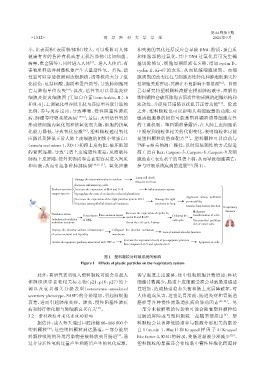
              和血液,从而引起各种肺部疾病               [14,16-17] 。氧化应激     参与呼吸系统疾病的进展 (图1)。

                                                                Lung cell death
                                   Damage the macromolecules in nucleus
                                                               Alveolar unit loss
                                  {
                                    Increase inflammatory cells
                         Produce reactive  Increase the expression of IL⁃6 and IL⁃8  Inflammatory response
                         oxygen species  Upregulate the ratio of oxidized to reduced glutathione
                                                                                       Aggravate airway epithelial
                                  { Decrease the expression of the tight junction protein ZO⁃1  Damage the tight  permeabiliby
                                                                         junctions in lung
                                    Decrease transepithelial electrical resistance
                                                                                       Impaire lung barrier furction
                                                                                                        Respiratory
                                                           Increase the expression of cyclin D,  Malignant  diseases
                         Oxidative stress      Base excision repair
                                       Peroxidation                              Delaying the  transformation of cells
                                                           cyclin E and Ki⁃67
                         Imbalanced oxidation  of DNA                            cell cycle  Uncontrolled prolifera⁃
                         reduction reactions               Arrest the cell cycle S phase
                                                                                          tion of tumor cells
                         Destroy the alveolar surface ultrastructure  Collapsed the alveolar surfactant
                                                                            Loss of normal alveolar function
                         of active material and liquidity  membrane
                                                          Increase the expression levels of pro⁃apoptotic proteins
                         Initiate the apoptotic pathway associated with TNF⁃α                Apoptosis of cells
                                                          Bax,Caspase⁃3,8,9 and cytochrome C
                                                 图1 塑料颗粒对呼吸系统的影响
                                      Figure 1 Effects of plastic particles on the respiratory system
                  此外,有研究表明吸入塑料颗粒可能会引起人                          诱导肠道上皮脱落,使中性粒细胞计数增加,杯状
              体肺组织中衰老相关标志物(p21、p16、p27)的上                       细胞计数减少;肠道上皮细胞受损会导致肠道通透

              调 以及衰老相关分泌表型(senescence⁃associated                性增加,造成肠道稳态失衡和肠上皮屏障破坏,对
              secretory phenotype,SASP)的分泌增加,引起肺细胞              人体造成危害,这也是胃溃疡、肠道炎症和胃肠道
              衰老,进而引起肺部炎症。肺炎、慢性阻塞性肺疾                            癌症等各种慢性胃肠道疾病的驱动因素                     [21-22] 。另
              病和肺纤维化都与肺细胞衰老有关 。                                 一部分未被解吸的污染物可能会随着塑料颗粒经
                                             [19]
                                                                                                        [9]
              3.2  塑料颗粒对消化系统的影响                                 过肠道屏障或与塑料颗粒一起随粪便排出 。塑
                  据估计,成人每天通过口腔接触86~168 000个                     料颗粒会显著降低肠道中与黏液分泌相关的黏蛋
              塑料颗粒    [20] ,这些塑料颗粒到达肠道,一部分被塑                    白 1(mucin 1,Muc1)和 Kruppel 样因子 4(Kruppel
                                                       [9]
              料颗粒吸附的环境污染物会被释放到胃肠道 ,通                            like factor 4,Klf4)的转录,使肠道黏液分泌减少           [22] 。
              过介导活性氧的过量产生和随后产生的氧化应激,                            塑料颗粒的暴露还会使结肠中囊性纤维化跨膜转

