


Page 153 - 南京医科大学自然版
P. 153
第45卷第12期            严舒桐,刘 琪. 机器学习在类风湿性关节炎诊疗及并发症预测中的研究进展[J].
                 2025年12月                    南京医科大学学报(自然科学版),2025,45(12):1834-1844                      ·1835 ·


                引起的长期慢性骨骼、关节炎症可导致疼痛、关节                            变量间的关联得出规律,因此被广泛应用于医疗领域
                                                                                                       [10]
                                               [3]
                畸形,严重可致滑膜组织失去功能 。目前主要采                            进行疾病诊断、预测疾病进展和药物研发等 。
                取抗风湿药的常规疗法来改善患者病情,最常使用                                ML 算法目前分为有监督、无监督、半监督和强
                的药物为甲氨蝶呤与糖皮质激素,它们能够抑制干                            化学习4种,监督学习通过标记数据进行训练,主要
                扰素等致炎因子、诱导白介素(interleukin,IL)⁃10                  包括分类分析与回归分析,常见模型有支持向量机
                等抗炎因子的产生,但该类药物长期使用会出现                            (support vector machine,SVM)、随 机 森 林(random
                明显的不良反应,如代谢紊乱、胃肠道溃疡和骨质                            forest,RF)、最小绝对收缩和选择运算符(least abso⁃
                疏松等,且该类药物仅能改善患者症状,难以根治                            lute shrinkage and selection operator,LASSO)等;无监
                  [4]
                RA 。现阶段 RA 的诊断主要依据患者临床表现、                         督学习对未标记数据进行处理,模型需要自己发现
                实验室检查以及影像学检查,但其早期症状无特异                            数据中的结构和模式,包括聚类、降维和特征学
                性 [5-6] ,常与骨关节炎等疾病混淆,现有指标也无法                      习;半监督学习兼具监督和无监督学习的特点,通
                全面反映疾病严重程度以及伴发并发症的风险,同                            过利用少量标记数据和大量未标记数据进行模型
                时由于人群异质性,不同患者对治疗药物的敏感度                            训练;强化学习通过与环境交互解决问题,通过不
                也存在明显差异       [7-9] ,亟待强化诊断体系以提高临床                断试错进行纠正        [11] 。不同算法各具优势,因此要
                对RA的治疗效力。                                         依据目的选择合适模型,当单一模型无法有效解
                    近年来人工智能(artificial intelligence,AI)逐渐         决问题时,亦可采用混合模型达到最优效果。现阶
                兴起,机器学习(machine learning,ML)作为 AI 的一              段RA诊疗模型常依托监督学习模式,主要应用算法
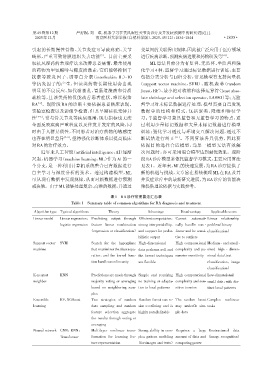
                个分支,是一种利用计算机系统整合已有数据进行                            见表1。近年来,ML的快速发展,为RA诊疗提供了
                自主学习与深度分析的技术。通过构建模型,ML                            新的机遇与挑战,文章旨在系统梳理ML在RA及其
                可从现有数据中发现规律,从而对新数据进行预测                            并发症诊疗中的最新研究进展,为RA诊疗的智能决
                或决策。由于ML能够处理复杂、高维的数据,并通过                          策提供理论依据与实践参考。

                                                    表1   RA诊疗常用算法汇总表
                                  Table 1 Summary table of common algorithms for RA diagnosis and treatment

                 Algorithm type Typical algorithms  Theory           Advantage      Disadvantage  Applicable scene
                Linear model  Linear regression, Predicting output through Efficient computation,Cannot  automati⁃ Linear relationship
                             logistic regression feature linear combination strong interpretability,cally handle non ⁃ problem(binary
                                          (regression or classification) and support for proba⁃ linear and be sensi⁃ classification)
                                                                 bilistic output  tive to outliers
                Support vector  SVM        Search for the hyperplane High⁃dimensional  High computational Medium ⁃ and small ⁃
                machine                    that maximizestheclasssepa⁃ data performs well and complexity and pa⁃ sized high ⁃ dimen⁃
                                           ration,and the kernel func⁃ the kernel techniques rameter sensitivity sional data(text
                                           tionhandles nonlinearity  are flexible                classification,image
                                                                                                 classification)
                K⁃nearest    KNN           Predictions are made through Simple and requiring High computational Low⁃dimensional
                neighbor                   majority voting or averaging no training or adapta⁃ complexity and sen⁃ small data,with dis⁃
                                           based on neighboring sam⁃ tion to local patterns  sitive to noise  tinct local patterns
                                           ples
                Ensemble     RF,XGBoost    Two strategies of random Random forest can re⁃ The random forest Complex  nonlinear
                learning                   data sampling and random sist overfitting and is may underfit sim⁃ tasks
                                           feature selection aggregate highly parallelizable  ple data
                                           the results through voting or
                                           averaging
                Neural network CNN,RNN,    Multilayer nonlinear trans⁃ Strong ability in com⁃ Requires a large Unstructured  data

                             Transformer   formation for learning fea⁃ plex pattern modeling amount of data and (image recognition)
                                           ture representation  (for images and texts) computing power

