


Page 153 - 《南京医科大学学报(自然科学版)》2026年第3期
P. 153
第46卷第3期      王安倩,李心竹,周辰宇. 无创生物标志物与人工智能多模态整合技术在阿尔茨海默病早期诊断与
                  2026年3月           筛查中的研究进展[J]. 南京医科大学学报(自然科学版),2026,46(3):457-465,474                 ·461 ·


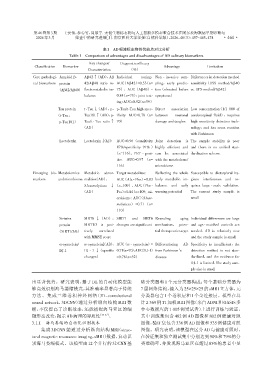
                                                表1 AD唾液标志物的优缺点对比分析
                                 Table 1 Comparison of advantages and disadvantages of AD salivary biomarkers
                                          Key changes/   Diagnostic efficacy
                 Classification  Biomarker                                   Advantage           Limitation
                                          Characteristics    (%)
                Core pathologi⁃ Amyloid β⁃  Aβ42↑(AD),Aβ Individual  testing:Non ⁃ invasive sam⁃ Differences in detection method
                cal biomarkers protein  42/Aβ40 ratio re⁃ AUC(Aβ42)=0.53(n= pling,early predic⁃ sensitivity(USS method/Aβ40
                            (Aβ42/Aβ40) flectsmetabolic im⁃ 75),AUC(Aβ40)= tion(elevated before vs. UPS method/Aβ42)
                                        balance        0.84(n=75);joint test⁃ symptoms)
                                                       ing:AUC=0.92(n=59)
                            Tau protein  t⁃Tau↓(AD),p⁃ p⁃Tau/t⁃Tau high spec⁃ Direct  association Low concentration(1/1 000 of
                           (t⁃Tau,      Tau181↑(AD),p⁃ ificity AUC=0.78(n= between  neuronal cerebrospinal fluid),requires
                            p⁃Tau181)   Tau/t ⁃ Tau ratio ↑ 70)          damage and tangles  high sensitivity detection tech⁃
                                       (AD)                                              nology,and has cross reaction
                                                                                         with Parkinson
                            Lactoferrin  Lactoferrin↓(AD) AUC=0.96(sensitivity Joint  detection  is The sample stability is poor
                                                       87%/specificity 91% ) highly efficient and and there is no unified stan⁃
                                                      (n=116); PET ⁃ posi⁃ can  be  associated dardization scheme
                                                       tive  AUC=0.97 (n= with the metabolome/
                                                       116)              microbiome

                Emerging bio⁃ Metabolomics  Metabolic  abnor⁃ Target metabolites:  Reflecting the whole Susceptible to dietary/oral hy⁃
                markers     and microbiome malities(AD),  AUC(Ala ⁃ Phe)=0.83 body metabolic im⁃ giene  interference  and  re⁃
                                        S.haemolyticus ↓ (n=109),AUC(Phe ⁃ balance  and  early quires large ⁃ scale validation.
                                       (AD)            Pro)=0.84(n=109; mi⁃ warning potential  The current study sample is
                                                       crobiome: AUC(S.hae⁃              small
                                                       molyticus) =0.71 (n=
                                                       110)

                            Sirtuins    SIRT6 ↓(AD),SIRT1     and  SIRT6 Revealing  aging Individual differences are large
                            protein     SIRT1/3 is posi⁃ changes are significant mechanism, poten⁃ and age ⁃ matched controls are
                            (SIRT1/3/6) tively  correlated               tial therapeutic target needed. AD is relatively new
                                        with MMSE score                                  and the study sample is small
                            α⁃synuclein/  α⁃synuclein↓(AD),AUC(α ⁃ synuclein)= Differentiating  AD Specificity is insufficient,the
                            DJ⁃1        DJ ⁃ 1 ↓(specific 0.71(n=70),AUC(DJ⁃1) from Parkinson’s  detection method is not stan⁃
                                        changes)       =0.78(n=52)       disease         dardized,and the evidence for
                                                                                         DJ⁃1 is limited. The study sam⁃
                                                                                         ple size is small

                出显著优势。研究表明,基于 DL 的自动化模型能                          础分类器和 1 个元分类器构成;每个基础分类器为
                够高效识别海马萎缩模式,其准确率显著高于传统                            7 层网络结构,输入为 25×25×25 的 sMRI 立方体,元

                方法。集成三维卷积神经网络(3D⁃convolutional                    分类器包含1个卷积层和1个全连接层。模型在总
                neural network,3DCNN)通过分析纵向结构 MRI 数               计2 369例T1加权MRI图像(来自ADNI和OASIS多
                据,不仅提高了诊断效率,还能捕捉海马亚区的细                            中心数据库的1 005例受试者)上进行训练与验证,
                微形态改变,揭示AD病理的异质性               [45-47] 。          其中训练集包含 482 例 AD 图像和 802 例健康对照
                3.1.1 海马萎缩的自动化识别技术                                图像,验证集包含336例AD图像和535例健康对照

                    集成 3DCNN 能通过分析纵向结构 MRI(struc⁃                 图像。研究表明,该模型在区分AD与健康对照时,
                tural magnetic resonance imaging,sMRI)数据,自动识      在验证集和独立测试集中分别达到90%和79%的分
                别海马萎缩模式。该模型由12个并行的3DCNN基                          类准确率,并发现海马亚区在超过85%的患者中呈

