


Page 136 - 南京医科大学自然版
P. 136
第45卷第1期
               ·130 ·                            南 京    医 科 大 学 学         报                        2025年1月


                                                                控及其在疾病进展中的动态变化机制,有助于开发
              3  药物研究进展
                                                                新型疾病治疗策略,提高治疗效果。未来,需要更
                  巨噬细胞在不同环境中可以分化为M1型和M2                         深入地探究巨噬细胞极化的详细机制,以精准调控
              型,对调控神经系统疾病具有重要作用。M1型具有                           其极化状态,充分阐明如何通过巨噬细胞极化来改
              促炎作用,可能会加剧疾病严重程度;而M2型则能                           善神经系统疾病的预后;同时开发更具特异性和高
              够抑制炎症反应,促进神经系统的修复和恢复。因                            效性的药物,降低不良反应;此外,还需开展大规模
              此,通过调控巨噬细胞的类型和数量,可为神经系                            临床试验,验证药物的实际效果和安全性。随着研
              统疾病的治疗提供重要靶点和途径。这一发现为                             究的不断深入,巨噬细胞极化相关药物的研究有望
              疾病治疗提供了新的方向,也为未来的研究和临床                            取得更大突破,为神经系统疾病的诊疗提供新思路

              实践提供参考。为此,文章总结了已证实可影响M1                           和方法。
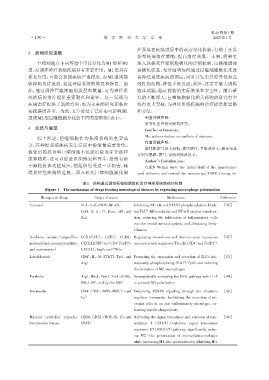
              型或M2型巨噬细胞分化的不同类型药物(表1)。                               利益冲突声明:
                                                                    所有作者声明无利益冲突。
              4  总结与展望                                              Conflict of Interests:
                  综上所述,巨噬细胞作为免疫系统的重要成                               The authors declare no conflicts of interests.
                                                                    作者贡献声明:
              分,在神经系统疾病发生发展中扮演着重要角色。
                                                                    陈伟凯撰写论文初稿,使用软件,并修改论文;唐金荣设
              极化后的抗炎型巨噬细胞不仅能清除炎症介质和
                                                                计研究思路,撰写、审阅和修改论文。
              废弃物质,还可以促进组织修复和再生,进而有助                                Author’s Contributions:
              于减轻机体炎症反应,使组织免受进一步损害,减                                CHEN Weikai wrote the initial draft of the manuscript,
              缓炎症性疾病的进展。深入研究巨噬细胞极化调                             used software,and revised the manuscript;TANG Jinrong de⁃

                                       表1 药物通过调控巨噬细胞极化治疗神经系统疾病的机制
                      Figure 1 The mechanism of drugs treating neurological diseases by regulating macrophage polarization

                    Therapeutic drugs        Target of action                 Mechanism                Reference
               Carnosol               IL⁃1,IL⁃6,iNOS,NF⁃κB,    Inhibiting NF⁃κB and STAT3 phosphorylation,block⁃  [41]
                                      COX⁃2,IL⁃17,Rorc,Irf4,and ing Th17 differentiation and NF⁃κB nuclear transloca⁃
                                      Batf                     tion,reducing the infiltration of inflammatory cells
                                                               into the central nervous system,and alleviating demy⁃
                                                               elination
               Antibiotic mixture(ampicillin,CCR1/CCL7, CCR7, CCR8,Regulating chemokines and their receptor expression  [42]
               metronidazole,neomycinsulfate,CXCL12(SDF⁃1α),CD4 FoxP3 ,associated with regulatory Th cells(CD4 and FoxP3 )
                                                       +
                                                            +
                                                                                                    +
                                                                                           +
               and vancomycin)        CXCL13,Arg1,and TNFα
                                          +
               Lenalidomide           CD4 ,IL⁃10,STAT3,Tyr1,and Promoting the expression and secretion of IL10,sub⁃  [43]
                                      Arg1                     sequently phosphorylating STAT3 Tyr1,and inducing
                                                               the formation of M2 macrophages
               Forskolin              Arg1,Mrc1,Fizz1,Ym1,CD86,Synergistically activating the ERK pathway with IL⁃4  [44]
                                             +
                                      NO,CD4 ,and Cyclic AMP   to promote M2 polarization
                                                          +
                                               +
                                          +
               Ivermectin             CD4 ,CD8 ,iNOS,MRC1 ,and Enhancing P2X4R signaling through the allosteric  [45]
                                      Ca 2+                    regulator ivermectin,facilitating the transition of mi⁃
                                                               croglia cells to an anti ⁃ inflammatory phenotype,en⁃
                                                               hancing myelin phagocytosis
               Myeloid epithelial reproduc⁃ CD16,CD32,iNOS,IL⁃10,and Activating the signal transducer and activator of tran⁃  [46]
               tive tyrosine kinase   STAT1                    scription 1( STAT1 )/cytokine signal transducer
                                                               repressor 1/3(SOCS1/3)pathway,significantly reduc⁃
                                                               ing M2 ⁃ like polarization of microglia/macrophages
                                                               while increasing M1⁃like polarization by inhibiting Mer

