


Page 123 - 南京医科大学自然版
P. 123
第45卷第5期             卢蓉蓉,瞿 菲,李 薇. 抗体偶联药物用于乳腺癌治疗的耐药机制研究进展[J].
                  2025年5月                     南京医科大学学报(自然科学版),2025,45(5):707-717                        ·709 ·

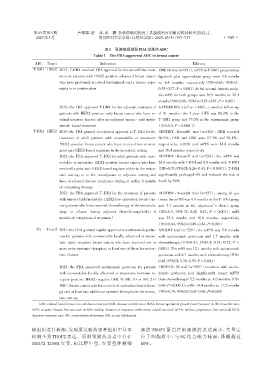
                                                 表1   乳腺癌领域获FDA批准的ADC
                                            Table 1 The FDA⁃approved ADC in breast cancer

                 ADC   Target                  Indication                                 Efficacy
                T⁃DM1 HER2 2013:T⁃DM1 received FDA approval for the second⁃line treat⁃ EMILIA trial(n=991):mPFS in T⁃DM1 group versus
                             ment in patients with HER2⁃positive advanced breast cancer lapatinib plus capecitabine group were 9.6 months
                             who have previously received trastuzumab and a taxane,sepa⁃ vs. 6.4 months,respectively(HR=0.65,95%CI:
                             rately or in combination                     0.55-0.77,P < 0.001)At the second interim analy⁃
                                                                          sis,mOS for both groups was 30.9 months vs. 25.1
                                                                          months(HR=0.68,95%CI:0.55-0.85,P < 0.001)
                             2019:the FDA approved T⁃DM1 for the adjuvant treatment of KATHERINE trial(n=1 486):a median follow⁃up
                             patients with HER2⁃positive early breast cancer who have re⁃ of 41 months ,the 3⁃year iDFS was 88.3% in the
                             sidual invasive disease after neoadjuvant taxane⁃ and trastu⁃ T⁃DM1 group and 77.0% in the trastuzumab group
                             zumab⁃ based treatment                      (HR=0.5,P < 0.000 1)
                T⁃DXd HER2 2019:the FDA granted accelerated approval to T⁃DXd for the DESTINY ⁃ Breast01 trial(n=184):ORR reached
                             treatment of adult patients with unresectable or metastatic 60.9% ;DCR and CBR were 97.3% and 76.1% ,
                             HER2⁃positive breast cancer who have received two or more respectively;mDOR and mPFS were 14.8 months
                             prior anti⁃HER2⁃based regimens in the metastatic setting  and 16.4 months,respectively
                             2022:the FDA approved T⁃DXd for adult patients with unre⁃ DESTINY ⁃ Breast03 trial(n=524):the mPFS was
                             sectable or metastatic HER2⁃positive breast cancer who have 28.8 months with T⁃DXd and 6.8 months with T⁃DM1
                             received a prior anti⁃HER2⁃based regimen either in the metas⁃ (HR=0.33,95%CI:0.26-0.43,P < 0.000 1). T⁃DXd
                             tatic setting,or in the neoadjuvant or adjuvant setting and significantly prolonged OS and reduced the risk of
                             have developed disease recurrence during or within 6 months death by 36%
                             of completing therapy
                             2022:the FDA approved T⁃DXd for the treatment of patients DESTINY ⁃ Breast04 trial(n=557):among all pa⁃
                             with unresectable/metastatic HER2⁃low expression breast can⁃ tients,the mPFS was 9.9 months in the T⁃DXd group
                             cer(patients who have received chemotherapy at the metastatic and 5.1 months in the physician’s choice group
                             stage or relapse during adjuvant chemotherapy/within 6 (HR=0.5,95% CI:0.40- 0.63,P < 0.001);mOS
                             months of completion of treatment)           was 23.4 months and 16.8 months,respectively
                                                                         (HR=0.64,95%CI:0.49-0.84,P=0.001)
                  SG   Trop⁃2 2021:the FDA granted regular approval to sacituzumab govite⁃ ASCENT trial(n=529):the mPFS was 5.6 months
                             can for patients with unresectable locally advanced or metas⁃ with sacituzumab govitecan and 1.7 months with
                             tatic triple⁃negative breast cancer who have received two or chemotherapy(HR=0.41,95%CI:0.32- 0.52,P <
                             more prior systemic therapies,at least one of them for metas⁃ 0.001). The mOS was 12.1 months with sacituzumab
                             tatic disease                                govitecan and 6.7 months with chemotherapy(HR=
                                                                          0.48,95%CI:0.38-0.59,P < 0.001)
                             2023:the FDA approved sacituzumab govitecan for patients TROPiCS⁃02 trial(n=543):treatment with sacitu⁃
                             with unresectable locally advanced or metastatic hormone re⁃ zumab govitecan had significantly longer mPFS
                             ceptor⁃positive,HER2⁃negative(IHC 0,IHC 1+or IHC 2+/ than chemotherapy(5.5 months vs. 4.0 months,HR=
                             ISH-)breast cancer who have received endocrine⁃based thera⁃ 0.66,P=0.000 3);mOS:14.4 months vs. 11.2 months
                             py and at least two additional systemic therapies in the metas⁃ (HR=0.79,95%CI:0.65-0.96,P=0.020)

                             tatic setting
                   CBR:clinical benefit rate;CI:confidence interval;DCR:disease control rate;HER2:human epidermal growth factor receptor⁃2;HR:hazards ratio;
                iDFS:invasive disease free survival;mDOR:median duration of response;mOS:mean overall survival;mPFS:median progression⁃free survival;ORR:
                objective response rate;IHC:immunohistochemistry;ISH:in situ hybrization.

                瘤组织进行检测,发现原发耐药患者组织中基本                             胞的 TROP2 蛋白在细胞膜的表达减少,大量定
                检测不到 TROP2 表达。而继发耐药患者中存在                          位于细胞质中,与 SG 结合能力减弱,降幅超过
                TROP2 T256R 突变,相比野生型,突变型肿瘤细                       80%。

