


Page 136 - 《南京医科大学学报》自然科学版2026年第2期
P. 136
第46卷第2期
               ·292 ·                            南 京    医 科 大 学 学         报                        2026年2月


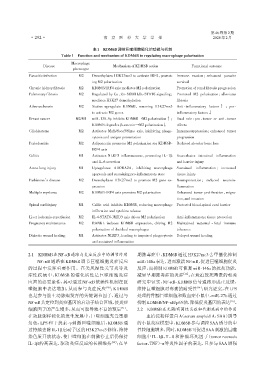
                                            表1 KDM6B调控巨噬细胞极化的功能与机制
                             Table 1 Function and mechanism of KDM6B in regulating macrophage polarization

                                  Macrophage
                     Disease                         Mechanism of KDM6B action            Functional outcome
                                   phenotype
              Parasitic infection    M2     Demethylates H3K27me3 to activate IRF4,promot⁃  Immune evasion;enhanced parasite
                                            ing M2 polarization                    survival
              Chronic kidney fibrosis  M2   KDM6B/IRF4 axis mediates M2 polarization  Promotion of renal fibrosis progression
              Pulmonary fibrosis     M2     Regulated by Cu,Zn⁃SOD/H2O2⁃STAT6 signaling; Promoted M2 polarization;alleviates
                                            mediates H3K27 demethylation           fibrosis
              Atherosclerosis        M2     Statins upregulate KDM6B,removing H3K27me3  Anti ⁃ inflammatory factors ↑ ;pro ⁃
                                            to activate M2 genes                   inflammatory factors↓
              Breast cancer         M2/M1   miR⁃138⁃5p inhibits KDM6B→M2 polarization↑; Dual role:pro ⁃ tumor or anti ⁃ tumor
                                            KDM6B degrades β⁃catenin→M2 polarization↓  effects
              Glioblastoma           M2     Activates Mafb/Socs3/Sirpa axis,inhibiting phago⁃  Immunosuppression;enhanced tumor
                                            cytosis and antigen presentation       progression
              Periodontitis          M2     Adiponectin promotes M2 polarization via KDM6B⁃  Reduced alveolar bone loss
                                            IRF4 axis
              Colitis                M1     Activates NLRP3 inflammasome,promoting IL⁃1β  Exacerbates intestinal inflammation
                                            and IL⁃6 secretion                     and barrier injury
              Acute lung injury      M1     Upregulates ADORA2A,inhibiting macrophage  Sustained  inflammation; increased
                                            apoptosis and sustaining pro⁃inflammatory state  tissue injury
              Parkinson’s disease    M2     Demethylates H3K27me3 to promote M2 gene ex⁃  Neuroprotection; reduced  neuroin⁃
                                            pression                               flammation
              Multiple myeloma       M2     KDM6B⁃IRF4 axis promotes M2 polarization  Enhanced tumor proliferation,migra⁃
                                                                                   tion,and invasion
              Spinal cord injury     M1     Gallic acid inhibits KDM6B,reducing macrophage  Protected blood⁃spinal cord barrier
                                            infiltration and cytokine release
              Liver ischemia⁃reperfusion  M2  IL⁃4⁃STAT6⁃JMJD3 axis drives M2 polarization  Anti⁃inflammatory;tissue protection
              Pregnancy maintenance  M2     RANKL induces KDM6B expression,driving M2  Maintained maternal ⁃ fetal immune
                                            polarization of decidual macrophages   tolerance
              Diabetic wound healing  M1    Activates NLRP3,leading to impaired phagocytosis  Delayed wound healing
                                            and sustained inflammation


              2.1 KDM6B在NF⁃κB通路与炎症反应中的调节作用                      期脓毒症中,KDM6B通过H3K27me3去甲基化抑制
                  NF⁃κB 通路在 KDM6B 调节巨噬细胞炎症反应                    miR⁃146a表达,进而激活NF⁃κB,促进巨噬细胞促炎
              的过程中发挥重要作用。在类风湿性关节炎等炎                             反应,而抑制KDM6B可恢复miR⁃146a的抗炎功能,
              症性疾病中,KDM6B 的催化活性是巨噬细胞炎症                          减轻早期脓毒症的炎症           [53] ;在炭疽致死毒素的相关
              应答的必要条件,其可通过NF⁃κB依赖性机制在巨                          研究中证实,NF⁃κB⁃KDM6B 信号通路形成正反馈,
              噬细胞中表达增加,从而参与炎症反应                  [50] ;KDM6B    维持巨噬细胞对毒素的耐受性 ;研究证实,在LPS
                                                                                           [54]
              也是参与腹主动脉瘤发育的关键调节因子,通过与                            处理的骨髓巨噬细胞和败血症小鼠中,miR⁃27b通过
                                                                                                           [55]
              NF⁃κB共定位到炎症基因的启动子结合区域,使炎症                         抑制KDM6B/NF⁃κB/p65轴,降低促炎基因的表达 。
              细胞因子的产生增多,从而可能导致不良的预后                     [51] 。  2.2 KDM6B在无菌/有菌性炎症和代谢疾病中的作用
              在动脉粥样硬化的发生发展中,巨噬细胞充当重要                                 血清淀粉样蛋白A(serum amyloid A,SAA)诱导
              角色,LPS 和干扰素⁃γ刺激巨噬细胞后,KDM6B 通                      的小鼠炎症模型中,KDM6B参与调控SAA诱导的中
              过持续去除IL⁃1β启动子区的H3K27me3修饰,维持                      性粒细胞增多,同时,KDM6B可促进SAA刺激的巨噬
              染色质开放状态,使巨噬细胞在刺激停止后仍保持                            细胞中 IL⁃1β、IL⁃8 和肿瘤坏死因子(tumor necrosis
              IL⁃1β的高表达,驱动炎症反应的长期维持                 [52] ;在早    factor,TNF)⁃α等炎性因子的表达,且参与SAA 增强

