


Page 116 - 南京医科大学自然版
P. 116
第46卷第8期
               ·1222 ·                           南 京    医 科 大 学 学         报                        2026年8月


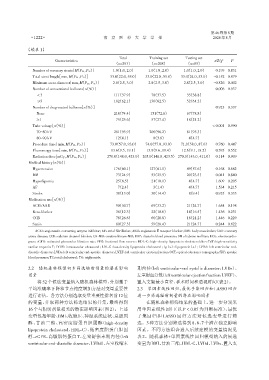
             (续表1)
                                                        Total         Training set     Testing set
                          Characteristics                                                           t/Z/χ 2  P
                                                      (n=293)         (n=208)          (n=85)
                Number of coronary stents[M(P25,P75 )]  1.0(1.0,2.0)  1.0(1.0,2.0)    1.0(1.0,2.0)   0.199 0.831
                Total stent length[mm,M(P25,P75 )]  33.0(22.0,55.0)  33.0(22.0,55.8)  33.0(24.0,53.0)  -0.152 0.879
                Minimum stent diameter[mm,M(P25,P75 )]  2.8(2.5,3.0)  2.8(2.5,3.0)    2.8(2.5,3.0)  -0.826 0.402
                Number of conventional balloons[n(%)]                                                0.006 0.937
                  <3                                  111(37.9)        78(37.5)        33(38.8)
                  ≥3                                  182(62.1)       130(62.5)        52(61.2)
                Number of drug⁃coated balloons[n(%)]                                                 0.923 0.337
                  None                                218(74.4)       151(72.6)        67(78.8)
                  ≥1                                   75(25.6)        57(27.4)        18(21.2)
                Tube voltage[n(%)]                                                                 < 0.001 0.990
                  70-80 kV                            281(95.9)       200(96.2)        81(95.3)
                  80-90 kV                             12(4.1)          8(3.8)          4(4.7)
                Procedure time[min,M(P25,P75 )]     73.0(57.0,93.0)  74.0(57.0,93.0)  71.0(58.0,87.0)  0.760 0.447
                Fluoroscopy time[min,M(P25,P75 )]   13.6(9.5,19.1)   13.9(9.6,19.4)  12.6(9.1,18.2)  0.595 0.552
                Radiation dose[mGy,M(P25,P75 )]   270.0(148.0,423.0) 265.0(148.0,423.5) 270.0(143.0,411.0)  0.114 0.909
              Medical history[n(%)]
                Hypertension                          176(60.1)       127(61.1)        49(57.6)      0.168 0.682
                DM                                     73(24.9)        53(25.5)        20(23.5)      0.041 0.840
                Hyperlipemia                           25(8.5)         21(10.1)         4(4.7)       1.609 0.205
                AF                                     7(2.4)           3(1.4)          4(4.7)       1.534 0.215
                Stroke                                 38(13.0)        30(14.4)         8(9.4)       0.935 0.333
              Medication use[n(%)]
                ACEI/ARB                               90(30.7)        69(33.2)        21(24.7)      1.654 0.198
                Beta⁃blocker                           36(12.3)        22(10.6)        14(16.5)      1.436 0.231
                CCB                                    78(26.6)        60(28.8)        18(21.2)      1.446 0.229
                Statin                                 80(27.3)        59(28.4)        21(24.7)      0.244 0.622
                 ACEI:angiotensin⁃converting enzyme inhibitor;AF:atrial fibrillation;ARB:angiotensinⅡreceptor blocker;BMI:body mass index;CAD:coronary
              artery disease;CCB:calcium channel blocker;CK⁃MB:creatine kinase⁃MB;DBP:diastolic blood pressure;DM:diabetes mellitus;ECG:electrocardio⁃
              gram;eGFR:estimated glomerular filtration rate;FFR:fractional flow reserve;HDL⁃C:high⁃density lipoprotein cholesterol;hs⁃cTnT:high⁃sensitivity
              cardiac troponin T;IVUS:intravascular ultrasound;LDL⁃C:low⁃density lipoprotein cholesterol;Lp(a):lipoprotein(a);LVDd:left ventricular end⁃
              diastolic diameter;LVDs:left ventricular end⁃systolic diameter;LVEF:left ventricular ejection fraction;OCT:optical coherence tomography;SBP:systolic
              blood pressure;TC:total cholesterol;TG:triglyceride.

              2.2  随机森林模型初步筛选辐射剂量的潜在影响                          期内径(left ventricular⁃end systolic diameter,LVDs)、
              因素                                                左室射血分数(left ventricular ejection fraction,LVEF)、
                  将52个候选变量纳入随机森林模型,分别基于                         置入支架最小直径、手术时间和透视时间(表2)。
              平均准确率下降和节点纯度增加方法对变量重要性                            2.3  单因素线性回归、最优子集回归和LASSO回归
              进行评估。各方法分别选取变量重要性排名前12位                           进一步筛选辐射剂量的潜在影响因素
              的变量,并取两种方法筛选结果的并集,最终得到                                 在随机森林初筛结果的基础上,进一步分别采
              16 个与辐射剂量相关的潜在影响因素(图2)。上述                         用单因素线性回归(以 P < 0.05 为判断标准)、最优
              变量包括年龄、BMI、收缩压、神经系统症状、总胆固                         子集回归和 LASSO 回归方法对候选变量进行筛

              醇、甘油三酯、高密度脂蛋白胆固醇(high⁃density                     选。3 种方法分别筛选得到 8、8、7 个潜在独立影响
              lipoprotein cholesterol,HDL⁃C)、低密度脂蛋白胆固           因素。不同方法组合进入后续建模的变量情况见

              醇、eGFR、高敏肌钙蛋白 T、左室舒张末期内径(left                     表 2。随机森林+单因素线性回归模型纳入的候选
              ventricular end⁃diastolic diameter,LVDd)、左室收缩末    变量为BMI、甘油三酯、HDL⁃C、LVDd、LVDs、置入支

