


Page 40 - 《南京医科大学学报》2026年第2期
P. 40
南京医科大学学报(社会科学版)京医科大学学报(社会科学版)                 第2期 总第133期
                                                    南
              · 142  ·
                                             Journal of Nanjing Medical University(Social Sciences)of Nanjing Medical University(Social Sciences)  2026年4月
                                             Journal


                      Comparative study of health resource allocation efficiency in

                Traditional Chinese Medicine(TCM) institutions across the Yangtze

                              River Economic Belt and the Yellow River Basin

                                                              1
                                                   GUO Mengzi ,TANG Zhiru  2
                  1. Human Resources Department,Jiaxing Hospital of Traditional Chinese Medicine,Jiaxing 314000;2. School of Health
                                        Management,Anhui Medical University,Hefei 230032,China
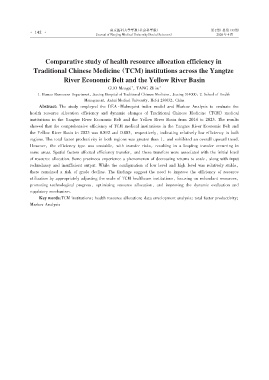
                   Abstract:The study employed the DEA ⁃ Malmquist index model and Markov Analysis to evaluate the
               health resource allocation efficiency and dynamic changes of Traditional Chinese Medicine (TCM) medical
               institutions in the Yangtze River Economic Belt and the Yellow River Basin from 2014 to 2023. The results
               showed that the comprehensive efficiency of TCM medical institutions in the Yangtze River Economic Belt and
               the Yellow River Basin in 2023 was 0.892 and 0.883,respectively,indicating relatively low efficiency in both
               regions. The total factor productivity in both regions was greater than 1,and exhibited an overall upward trend.
               However,the efficiency type was unstable,with transfer risks,resulting in a leapfrog transfer occurring in
               some areas. Spatial factors affected efficiency transfer,and these transfers were associated with the initial level
               of resource allocation. Some provinces experience a phenomenon of decreasing returns to scale,along with input
               redundancy and insufficient output. While the configuration of low level and high level was relatively stable,
               there remained a risk of grade decline. The findings suggest the need to improve the efficiency of resource
               utilization by appropriately adjusting the scale of TCM healthcare institutions,focusing on redundant resources,
               promoting technological progress,optimizing resource allocation,and improving the dynamic evaluation and
               regulatory mechanism.
                   Key words:TCM institutions;health resource allocation;data envelopment analysis;total factor productivity;
               Markov Analysis

