


Page 142 - 南京医科大学自然版
P. 142
第45卷第8期
               ·1198 ·                           南 京    医 科 大 学 学         报                        2025年8月


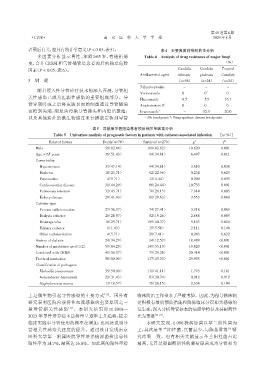
              者预后有关,差异有统计学意义(P < 0.05,表5)。                                 表4 主要真菌药物耐药性分析
                  多因素分析显示男性、年龄≥65 岁、有透析病                            Table 4  Analysis of drug resistance of major fungi
              史,合并 CRBSI 和气管插管是患者预后的独立危险                                                                (%)
              因素(P < 0.05,表6)。                                                     Candida   Candida   Tropical
                                                                  Antibacterial agent  albicans  glabrata  Candida
              3  讨 论                                                               (n=56)    (n=24)    (n=24)
                                                                  5⁃fluorocytosine    -         -         -
                  随着侵入性导管诊疗技术的深入开展,导管相
                                                                                                *
                                                                  Voriconazole       0.0       00 .0      0.
              关性感染已成为医源性感染的重要组成部分。导
                                                                  Fluconazole        6.5       05.9 *    16.7
              管穿刺时或之后将皮肤表面的细菌通过导管隧道                               Amphotericin B *   0.0       00 .0      0.
                                                                                                *
              定植到尖端,病原菌污染导管接头和内腔后繁殖,                              Itraconazole *      -        12.5      20.0
              以及其他病灶的微生物通过血行播散定植到导管                                 -:No breakpoint;*:Using epidemic disease breakpoints.
                                            表5 导管相关性感染患者预后相关单因素分析
                          Table 5 Univariate analysis of prognostic factors in patients with catheter⁃associated infection  [n(%)]

                        Related factors          Death(n=70)       Survivor(n=270)        χ 2           P
                  Male                            58(82.86)          168(62.62)         10.620         0.001
                  Age ≥ 65 years                  36(51.43)          094(34.81)          6.497         0.011
                  Comorbidity
                   Hypertension                   33(47.14)          094(34.81)          3.610         0.058
                   Diabetes                       18(25.71)          062(22.96)          0.234         0.629
                   Pancreatitis                   4(5.71)             12(4.44)           0.200         0.655
                   Cardiovascular disease         31(44.29)          066(24.44)         10.733         0.001
                   Pulmonary infection            32(45.71)          076(28.15)          7.914         0.005
                   Kidney disease                 29(41.43)          080(29.63)          3.553         0.060
                  Catheter type
                   Venous catheterization         27(38.57)          074(27.41)          3.318         0.069
                   Dialysis catheter              20(28.57)          052(19.26)          2.888         0.089
                   Drainage tube                  18(25.71)          109(40.37)          5.103         0.024
                   Urinary catheter               1(1.43)             15(5.56)           2.111         0.146
                   Other catheterization          4(5.71)             20(7.41)           0.243         0.622
                  History of dialysis             24(34.29)          034(12.59)         18.489        <0.001
                  Number of antibiotics used(≥2)  59(84.29)          149(55.19)         19.820        <0.001
                  Combined with CRBSI             41(58.57)          079(29.26)         20.914        <0.001
                  Tracheal intubation             56(80.00)          117(43.33)         29.903        <0.001
                  Classification of pathogens
                   Klebsiella pneumoniae          35(50.00)          111(41.11)          1.793         0.181
                   Acinetobacter baumannii        22(31.43)          083(30.74)          0.012         0.912
                   Staphylococcus aureus          13(18.57)          076(28.15)          2.638         0.104

              上是微生物引起导管感染的主要方式                   [11] 。国外有      临床防治工作带来了严峻考验。因此,为指导临床制
              研究表明医院内获得性血流感染的重要原因之一                             定积极有效的预防措施和降低临床导管相关感染的
              是导管相关性感染          [12] 。本研究结果显示 2018—             发生率,深入分析导管标本的病原学特征及其耐药性
              2023 年导管培养标本送检量呈逐年上升趋势,提示                         尤为重要    [13-14] 。
              临床实践中导管使用的频率在增加,也间接说明导                                 本研究发现,1 096 株病原菌以革兰阴性菌为
              管相关性感染关注度的提升。通过统计发现南京                             主,其次是革兰阳性菌,真菌最少,与陈慧君等                     [15] 研
              医科大学第一附属医院导管培养病原菌检出总体                             究结果一致。也有相关文献显示革兰阳性菌占比
              阳性率为14.7%,最高达16.8%。如此高的阳性率给                       最高,尤其是凝固酶阴性的葡萄球菌成为导管相关

