


Page 12 - 《南京医科大学学报(自然科学版)》2025年第9期
P. 12
第45卷第9期
               ·1224 ·                           南 京    医 科 大 学 学         报                        2025年9月


              A                                 B                           Kla KEGG pathway enrichment
                                                                                      Top 20 of KEGG enrichment
                        OC         Control                                      Ribosome         17(0.000 47)
                        338    74   294                   Protein processing in endoplasmic reticulum  18(0.000 49)
                                                                             Focal adhesion        20(0.000 49)
                                                              Complement and coagulation cascades  12(0.001 5)
                                                  Endocrine and other factor⁃regulated calcium reabsorption  9(0.002)
                                                                          Salmonella infection    19(0.003)
                                                                             Prion diseases  7(0.000 2)
                               UP                                         Carbon metabolism    13(0.003 4)
                                10                                                                        P value
                                                                      ECM⁃receptor interaction  11(0.003 4)
                                16                                     Proteoglycans in cancer   17(0.008 6)  0.03
                               Down                                                                        0.02
                                                                           Adherens junction  9(0.009)
                                                                Bacterial invasion of epithelial cells  9(0.014)  0.01
              C                                         2                      Amoebiasis      14(0.025)
                                               SPTBN1          Pathogenic Escherichia coli infection  19(0.027)
                                               PTGIS    1                      Spliceosome    12(0.029)
                                               DNAH11                        RNA transport     13(0.002)
                                               EPB41L2  0                      Necroptosis     13(0.033)
                                               DST
                                                                           Platelet activation  11(0.034)
                                               FN1      -1      Antigen processing and presentation  8(0.034)
                                               CCDC178                                     5(0.009)
                                               DNAH17   -2            Citrate cycle(TCA cycle)
                                               GNAL                                     0   3   6  9
                                               TRIM28                                     Gene percent(%)
                                               TTN
                                               ANXA6
                                               RPS23
                                               SAMHD1
                                               PARP1
                                               C6
                                               VPS13C
                                               FPR1
                                               HSPA1A
                                               HSPA4
                                               SMCHD1
                                               APEX1
                                               SEC24B
                       CTR1  CTR2  CTR3  OC1  OC2  OC3
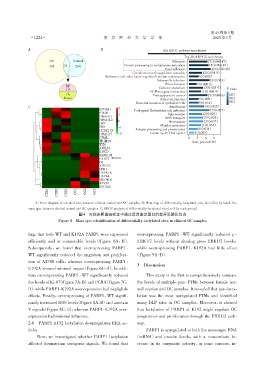
                 A:Venn diagram of selected sites between clinical control and OC samples. B:Heat map of differentially⁃lactylated sites identified by label⁃free
              mass spec between clinical control and OC samples. C:KEGG analysis of differentially⁃lactylated sites(n=3 for each group).
                                     图4 在临床卵巢癌样本中通过质谱鉴定蛋白的差异乳酸化位点
                            Figure 4 Mass spec identification of differentially⁃lactylated sites in clinical OC samples


              ting,that both WT and K192A PARP1 were expressed  overexpressing PARP1 ⁃ WT significantly reduced p ⁃
              efficiently and at comparable levels(Figure 6A,B).  ERK1/2 levels without altering gross ERK1/2 levels,
              Subsequently,we found that overexpressing PARP1 ⁃  while overexpressing PARP1 ⁃ K192A had little effect
              WT significantly reduced the migration and prolifera⁃  (Figure 9A-D).
              tion of A2780 cells,whereas overexpressing PARP1⁃
                                                                3  Discussion
              K192A showed minimal impact(Figure 6C-F). In addi⁃
              tion,overexpressing PARP1 ⁃ WT significantly reduced   This study is the first to comprehensively compare
              the levels of Ki⁃67(Figure 7A,B)and PCNA(Figure 7C,  the levels of multiple pan⁃PTMs between female nor⁃

              D),while PARP1⁃K192A overexpression had negligible  mal ovarian and OC samples. It revealed that pan⁃lacty⁃
              effects. Finally,overexpressing of PARP1 ⁃ WT signifi⁃  lation was the most upregulated PTMs and identified
              cantly increased ROS levels(Figure 8A,B)and annexin  many DLP sites in OC samples. Moreover,it showed
              V signals(Figure 8C,D),whereas PARP1⁃K192A over⁃  that lactylation of PARP1 at K192 might regulate OC
              expression had minimal influence.                 progression and proliferation through the ERK1/2 path⁃
              2.4  PARP1 K192 lactylation downregulates ERK ac⁃  way.
              tivity                                                 PARP1 is upregulated at both the messenger RNA
                  Next,we investigated whether PARP1 lactylation  (mRNA)and protein levels,with a concomitant in⁃
              affected downstream oncogenic signals. We found that  crease in its enzymatic activity,in some cancers,in⁃

