


Page 92 - 《南京医科大学学报(自然科学版)》2026年第3期
P. 92
第46卷第3期
               ·400 ·                            南 京    医 科 大 学 学         报                        2026年3月


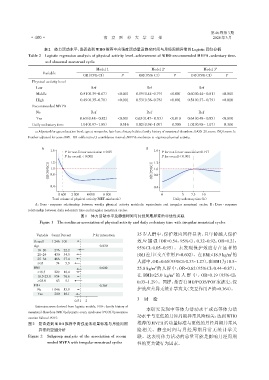
                     表2 体力活动水平、是否达到WHO推荐中高强度活动量及静坐时间与月经周期异常的Logistic回归分析
              Table 2  Logistic regression analysis of physical activity level,achievement of WHO⁃recommended MVPA,sedentary time,
                      and abnormal menstrual cycle

                                              Model 1                  Model 2 a               Model 3 b
                     Variable
                                       OR(95% CI)        P       OR(95% CI)      P       OR(95% CI)      P
                Physical activity level
                  Low                      Ref                       Ref                     Ref
                  Middle              0.51(0.39-0.67)  <0.001   0.59(0.44-0.79)  <0.001  0.60(0.44- 0.81)  <0.001
                  High                0.49(0.35-0.70)  <0.001   0.53(0.36-0.76)  <0.001  0.54(0.37- 0.79)  <0.010
                Recommended MVPA
                  No                       Ref                       Ref                     Ref
                  Yes                 0.63(0.48- 0.82)  <0.001  0.63(0.47- 0.83)  <0.010  0.64(0.48- 0.85)  <0.010
                Daily sedentary time  1.01(0.97-1.05)   0.516   1.02(0.98-1.07)  0.300  1.02(0.98- 1.07)  <0.300
                 a:Adjusted for age,education level,age at menarche,hair loss,dietary habits,family history of menstrual disorders,DASS⁃21 score,PSQI score. b:
              Further adjusted for acne,BMI. OR:odds ratio;CI:confidence interval;MVPA:moderate⁃to⁃vigorous physical activity.

                    A                                               B
                        1.6                                             1.6
                               P for non⁃linear association < 0.05          P for non⁃linear association=0.197
                               P for overall < 0.001                        P for overall < 0.001
                        (95%CI)  1.2                                   (95%CI)  1.2
                        1.0
                                                                        1.0
                        OR 0.8                                         OR  0.8

                        0.4                                             0.4

                            0 600  2 000  4 000  6 000                     0         5   7.5  10
                         Total volume of physical activity(MET⁃min/week)         Daily sedentary time(h)
                 A:Dose ⁃ response relationship between weekly physical activity metabolic equivalents and irregular menstrual cycles. B:Dose ⁃ response
              relationship between daily sedentary time and irregular menstrual cycles.
                                      图1 体力活动水平及静坐时间与月经周期异常的非线性关联
                   Figure 1 The nonlinear association of physical activity and daily sedentary time with irregular menstrual cycles

                                                                35 岁人群中,保护效应同样显著,且年龄越大保护
                  Variable  Count Percent   P for interaction
                 Overall  1 246 100                             效 应 越 强(OR=0.54,95% CI:0.32~0.92;OR=0.21,
                 Age                           0.030            95%CI:0.05~0.95)。未发现保护效应存在显著的
                  18-20   276  22.2
                                                                                                            2
                  21-24   430  34.5                             BMI差异(交互作用P=0.602)。在BMI<18.5 kg/m 的
                  25-34   466  37.4
                                                                人群中,OR=0.65(95%CI:0.33~1.27),在BMI为18.5~
                  ≥35      74  5.9
                                                                         2
                 BMI                           0.602            25.0 kg/m 的人群中,OR=0.62(95%CI:0.44~0.87),
                  <18.5   229  18.4
                                                                在 BMI≥25.0 kg/m 的 人 群 中 ,OR=0.19(95% CI:
                                                                                 2
                  18.5⁃25.0  954  76.6
                  ≥25.0    63  5.1                              0.03~1.29)。同样,是否有MD/PCOS/POF家族史,保
                 FH+                           0.364
                  No     1 046  83.9                            护效应差异无统计学意义(交互作用P值=0.364)。
                  Yes     200  16.1
                                                                3  讨 论
                                    0.5 1  2
                 Estimates were derived from logistic models. FH+,family history of
                                                                     本研究发现中等体力活动水平或高等体力活
              menstrual disorders(MD)/polycystic ovary syndrome(PCOS)/premature
                                                                动水平与更低的月经周期异常风险相关,达到WHO
              ovarian failure(POF).
              图2   是否达到WHO推荐中高强度活动量标准与月经周期                      推荐的MVPA活动量标准与更低的月经周期异常风
                   异常的亚组分析                                      险相关。静坐时间与月经周期异常无统计学关
              Figure 2  Subgroup analysis of the association of recom ⁃  联。这表明体力活动的总量可能是影响月经周期
                       meded MVPA with irregular menstrual cycles  性的更关键行为因素。

