


Page 135 - 南京医科大学自然版
P. 135
第46卷第9期      孟明辉,陈正新,王慧博. 翻译后修饰介导的膜表面稳态调控与胶质母细胞瘤免疫可见性重塑[J].
                  2026年9月                     南京医科大学学报(自然科学版),2026,46(9):1398-1411                      ·1405 ·


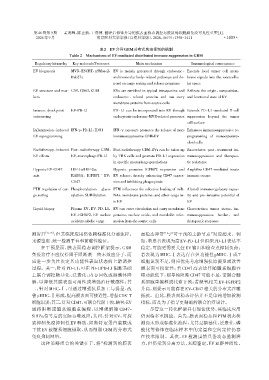
                                               表2 EV介导GBM分布式免疫抑制的机制
                                 Table 2 Mechanisms of EV⁃mediated distributed immune suppression in GBM

                 Regulatory hierarchy  Key molecule/Processes   Main mechanism           Immunological consequence
                EV biogenesis     MVB,ESCRT,nSMase2,EV is mainly generated through endosome ⁃ Extends local tumor cell mem⁃
                                  Rab27a             multivesicular body⁃related pathways and de⁃ brane signals into the extracellu⁃
                                                     pend on cargo sorting and release programs  lar space
                EV structure and mar⁃ CD9,CD63,CD81  EVs are enriched in typical tetraspanins and Reflects the origin,composition,
                kers                                 endosome ⁃ related proteins and can carry and functional state of EV
                                                     membrane proteins from source cells

                Immune checkpoint  EV⁃PD⁃L1          PD⁃L1 can be incorporated into EV through Extends PD⁃L1⁃mediated T cell
                outsourcing                          endocytosis⁃endosome⁃MVB⁃related processes suppression beyond the tumor
                                                                                       cell surface
                Inflammation ⁃ induced IFN⁃γ,PD⁃L1,IDO1  IFN⁃γ exposure promotes the release of more Enhances immunosuppressive re⁃
                EV reprogramming                     immunosuppressive GBM⁃EV          programming of monocytes/my⁃
                                                                                       eloid cells
                Radiotherapy ⁃ induced Post ⁃ radiotherapy GBM ⁃ Post⁃radiotherapy GBM⁃EVs can be taken up Exacerbates post ⁃ treatment im⁃
                EV effects        EV,macrophage PD⁃L1  by TME cells and promote PD⁃L1 expression munosuppression and therapeu⁃
                                                     in specific macrophage populations  tic resistance
                Hypoxia⁃EV⁃CD47   HIF⁃1α/HIF⁃2α,     Hypoxia promotes IGFBP2 expression and Amplifies CD47⁃mediated innate
                axis              RAB3A,IGFBP2  +  EV,EV release,thereby enhancing CD47 expres⁃ immune escape
                                  CD47               sion and inhibiting phagocytosis
                PTM regulation of car⁃ Phosphorylation, glyco⁃ PTM influences the selective loading of miR⁃ Altered immunoregulatory capac⁃
                go sorting        sylation,SUMOylation  NAs,membrane proteins,and other cargo in⁃ ity and pro ⁃ invasive potential of
                                                     to EV                             EV
                Liquid biopsy     Plasma EV,EV⁃PD⁃L1,EV can enter circulation and carry membrane Characterizes tumor status,im⁃
                                  EV⁃IGFBP2,EV nucleic proteins,nucleic acids,and metabolic infor⁃ munosuppressive  burden, and
                                  acids/metabolic cargo  mation from the source cells  therapeutic response


                测窗口   [91,95] ,但其临床应用仍依赖标准化分离流程、                  面稳态异常”与“可干预的上游节点”对应起来。例
                来源鉴定、统一检测平台和前瞻性验证。                                如,若患者表现为高EV⁃PD⁃L1但组织PD⁃L1表达不
                    在干预层面,膜表面稳态调控框架提示,GBM                         稳定,可能更需要关注EV输出和检查点抑制负荷;
                免疫治疗不应仅停留于阻断某一终末效应分子,而                            若表现为 MHC⁃Ⅰ表达存在但功能性 pMHC⁃Ⅰ或 T
                应进一步关注决定其功能性表面状态的上游调控                             细胞识别不足,则应优先考虑增强抗原提呈或改善
                过程。其一,针对PD⁃L1,可在PD⁃1/PD⁃L1阻断基础                    膜表面可接近性;若 CD47 高表达伴随髓系细胞吞
                上联合调控糖基化、泛素化、内吞回收或溶酶体降                            噬功能低下,则单纯阻断CD47可能不足,需联合髓
                解,以降低其膜表面可用性或增强治疗敏感性;其                            系细胞重编程或代谢干预;若缺氧相关 EV⁃IGFBP2
                二,针对 MHC⁃Ⅰ,可通过增强抗原加工与提呈、改                         升高,则提示可能存在EV⁃CD47相关的分布式吞噬

                                                            +
                善 pMHC⁃Ⅰ形成、提高膜表面可接近性,增强CD8 T                      抵抗。由此,膜表面稳态评估并不是单纯增加检测
                细胞识别;其三,针对CD47,可联合代谢干预、缺氧⁃EV                      指标,而是为了指导更精确的联合治疗设计。
                通路阻断或髓系细胞重编程,以增强解除 CD47⁃                              尽管这一转化框架具有理论优势,其临床应用
                SIRPα信号后的实际吞噬效应;其四,针对EV,可探                        仍面临多重挑战。首先,膜表面稳态和PTM状态检
                索抑制免疫抑制性 EV 释放、阻断特定蛋白装载或                          测尚未形成标准化流程,尤其是糖基化、泛素化、磷
                干扰 EV 被髓系细胞摄取,从而削弱 GBM 的分布式                       酸化等修饰在临床样本中的定量和空间定位仍存
                免疫抑制网络。                                           在技术限制。其次,EV 检测虽然具备动态监测潜
                    这种策略组合的关键在于,将“检测到的膜表                          力,但仍受到分离方法、来源鉴定、EV 亚群异质性、

