


Page 146 - 南京医科大学自然版
P. 146
第45卷第12期
               ·1828 ·                           南 京    医 科 大 学 学         报                        2025年12月


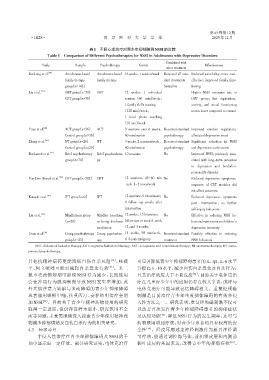
                                          表1 不同心理治疗对青少年抑郁障碍NSSI的比较
                       Table 1 Comparison of Different Psychotherapies for NSSI in Adolescents with Depressive Disorders

                                                                              Combined with
                    Study           Sample     Psychotherapy     Format                         Effectiveness
                                                                              other treatment
                       [69]
              Bockting et al.  Attachment⁃based  Attachment⁃based 16 weeks,1 session/week  Received all stan⁃ Reduced suicidality;more cost⁃
                               family therapy  family therapy                dard treatments  effective;improved family func⁃
                               group(n=142)                                  Sertraline  tioning
              Liu et al. [73]  DBT group(n=50)  DBT        12 weeks:1 individual         Higher NSSI remission rate in
                               CBT group(n=50)             session (60 min)/week;        DBT group;but depression,
                                                           1 family skills training      anxiety,and social functioning
                                                          (120 min)/week;                scores lower compared to control
                                                           1 brief phone coaching
                                                          (10 min)/week
              Yuan et al. [65]  ACT group(n=36)  ACT       9 sessions over 6 weeks,Received standard Improved emotion regulation;
                               Control group(n=36)         60 min/session    psychotherapy  alleviated depressive mood
              Zhang et al. [74]  NT group(n=26)  NT        3 weeks,2 sessions/week, Received standard Significant reduction in NSSI
                               Control group(n=29)         60 min/session    psychotherapy  and depression scale scores
                        [71]
              Rockstroh et al.  Brief psychotherapy  Brief psychothera⁃ 10 sessions  No  Improved NSSI;positively asso⁃
                               group(n=74)    py                                         ciated with long ⁃ term outcomes
                                                                                         in depression and borderline
                                                                                         personality disorder
              Van Den Heuvel et al. [75]  CBT group(n=282)  CBT  12 sessions,45-60 min No  Reduced depressive symptoms;
                                                           each,1-2 times/week           sequence of CBT modules did
                                                                                         not affect outcomes
                      [76]                                 12 sessions,5 times/week;
              Katsuki et al.   IPT group(n=2)  IPT                           No          Reduced depressive symptoms
                                                           4 follow ⁃ up emails after    post ⁃ intervention;no further
                                                           intervention                  self⁃injury behaviors
              Liu et al. [72]  Mindfulness group  Mindful breathing  12 weeks,1.5 h/session;  No  Effective in reducing NSSI be⁃
                               (n=29)         or loving⁃kindness  follow⁃ups at week 6,week  haviors;lowerscoresonchildren’s
                                              meditation   12,and 3 months               depression inventory
                     [77]                                  14 weeks,90 min/week,
              Gratz et al.     Group psychotherapy  Group psychother⁃        Received standard Possibly effective in reducing
                               group(n=23)    apy          4-6 patients/group  treatment  NSSI behaviors
                 DBT:dialectical behavior therapy;CBT:cognitive behavioral therapy;ACT:acceptance and commitment therapy;NT:narrative therapy;IPT:inter⁃
              personal psychotherapy.

              其他抗精神病药更能降低自伤自杀风险                     [91] ,喹硫    可显著降低青少年抑郁障碍患者的IL⁃1β、IL⁃6水平
              平、阿立哌唑可能对减轻自杀意念有效                    [92] 。苯二     并提高IL⁃10水平,减少自伤自杀意念及自杀行为,
              氮卓类药物短期可能使 NSSI 行为减少,长期使用                         且其治疗效应大于不良反应              [94] ,目前关于电休克治
              会使冲动行为脱抑制而导致 NSSI 发生率增加,此                         疗在儿童青少年中的应用仍存在较大争议,或许与
              外共病注意力缺陷与多动障碍的青少年抑郁障碍                             电休克治疗可能导致记忆障碍相关。重复经颅磁
              患者服用哌醋甲酯、托莫西汀、安非他明治疗会增                            刺激是目前治疗青少年重度抑郁障碍的有效非侵
                    [93]
              加 NSSI   。目前关于青少年精神药物使用的研究                        入性方法之一。研究表明,重复经颅磁刺激不仅可
              取得一定进展,但仍存在样本量小、研究范围不全                            以改善首次发作青少年抑郁障碍患者的抑郁症状
              面等问题,未来需继续深入探索青少年使用精神药                            及认知功能      [95] ,降低 NSSI 行为的发生频率,还可与
              物减少抑郁情绪及自伤自杀行为的相关研究。                              药物联用增加疗效,对青少年患者均具有较高的安

              4.3  物理治疗                                         全性  [96] 。经皮耳廓迷走神经刺激作为新兴神经调
                  非侵入性治疗在青少年抑郁障碍及 NSSI 的干                       节疗法,能通过调控海马体、前扣带皮层和内侧前
              预中显示出一定疗效。部分研究证实,电休克治疗                            额叶皮层的基因表达,改善青少年的抑郁症状                       [97] 。

