


Page 14 - 南京医科大学自然版
P. 14
第45卷第2期
               ·154 ·                            南 京    医 科 大 学 学         报                        2025年2月


                        200                                                                     ABC⁃2
                        180                                                                     ABC⁃17
                                                                                                ABC⁃18
                        160                                                                     ABC⁃56
                       Fluorescence intensity  120                                              ssDNA pool
                        140
                                                                                                ABC⁃82
                        100
                        80
                        60
                        40
                        20
                         0
                            SKBR3   MCF⁃7  MDA⁃MB⁃231 MCF⁃10A SGC⁃7901  A549  SW480  A2780  HepG2  PANC⁃1
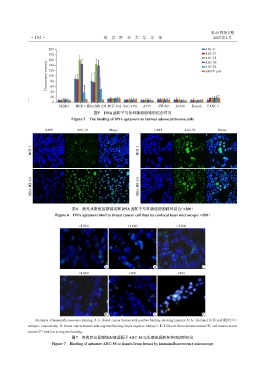
                                            图5 DNA适配子与各种腺癌细胞的结合情况
                                  Figure 5 The binding of DNA aptamers to various adenocarcinoma cells


                      DAPI           ABC⁃18        Merge                DAPI          ABC⁃56          Merge


               MCF⁃7                                             MCF⁃7


               MDA⁃MB⁃231                                        MDA⁃MB⁃231


                                  图6 激光共聚焦显微镜观察DNA适配子与乳腺癌细胞株的结合(×200)
                          Figure 6 DNA aptamers bind to breast cancer cell lines by confocal laser microscope(×200)


                                     ×1 000                 ×1 000                ×1 000


                                                 A                      B                     C
                                     ×1 000                  ×400                  ×400


                                                 D                      E                     F
                 Analysiss of immunofluorescence staining. A⁃C:Breast cancer tissues with positive binding,showing Luminal A(A),Luminal B(B)and HER2(C)
              subtype,respectively. D:Breast cancer tissues with negative binding(triple negative subtype). E,F:Breast fibroadenoma tissues(E)and normal breast
              tissues(F)with low or negative binding.
                                  图7 免疫荧光显微镜观察适配子ABC⁃56与乳腺来源的各种组织的结合
                         Figure 7 Binding of aptamer ABC⁃56 to tissues from breast by immunofluorescence microscope

