


Page 91 - 南京医科大学自然版
P. 91
第45卷第4期         秦 浩,谢卫国,陈小红,等. 基于16S核糖体RNA高通量测序前瞻性分析50岁及以上重度
                  2025年4月         烧伤患者早期肠道菌群变化[J]. 南京医科大学学报(自然科学版),2025,45(4):523-534                   ·527 ·


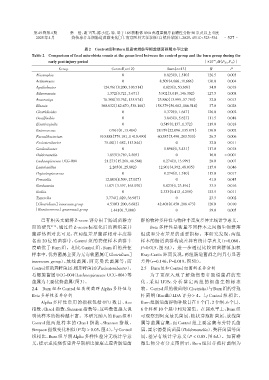
                                        表2 Control组和Burn组患者烧伤早期粪便菌群属水平比较
                Table 2  Comparison of fecal microbiota counts at the genus level between the control group and the burn group during the
                       early post⁃injury period                                                [×10 ,M(P25,P75 )]
                                                                                                   -4
                            Group                    Control(n=12)            Burn(n=13)          W        P
                  Abiotrophia                            0                   0.823(0,1.510)      126.5    0.003
                  Actinomyces                            0                 8.509(4.666,11.666)   130.0    0.004
                  Agathobacter                   124.961(8.200,310.514)     0.823(0,50.369)       34.0    0.018
                  Akkermansia                     1.372(0.721,3.671)      5.902(3.019,146.302)   127.5    0.008
                  Anaerostips                    76.308(33.762,135.974)   23.880(13.999,57.780)   32.0    0.013
                  Blautia                       300.632(182.670,538.168)  158.379(56.682,186.514)  37.0   0.028
                  Clostridioides                         0                   1.372(0,1.647)      126.0    0.002
                  Desulfovibio                           0                   3.843(0,5.627)      111.5    0.048
                  Eisenbergiella                         0                 0.549(0.137,1.372)    119.0    0.018
                  Enterococcus                      0.961(0,13.484)      28.959(22.096,135.871)  136.0    0.002
                  Faecalibacterium             910.888(579.101,1 410.490)  60.387(5.490,203.533)  26.5    0.006
                  Fusicatenibacter               75.48(11.082,113.844)            0               32.0    0.011
                  Gordonibacter                          0                   1.098(0,3.431)      117.0    0.018
                  Holdemanella                    1.853(0.789,2.505)              0               16.0   < 0.001
                  Lachnospiraceae UCG⁃004        21.273(15.268,48.584)      0.274(0,13.999)       28.0    0.007
                  Lactobacillus                     2.265(0,25.802)       12.901(4.392,48.035)   115.0    0.046
                  Peptostreptococcus                     0                   0.274(0,1.510)      115.0    0.017
                  Prevotella                      12.803(8.509,27.027)            0               41.0    0.045
                  Romboutsia                     11.871(3.397,165.070)      0.823(0,23.194)       33.5    0.016
                  Rothia                                 0                 2.333(0.412,4.255)    123.5    0.011
                  Tyzzerella                      3.774(1.029,36.987)             0               23.5    0.002
                 [Clostridium]innocuum group      4.530(1.200,6.682)      42.408(6.450,208.473)  126.0    0.010
                 [Ruminococcus]gauvreauii group     1.441(0,7.000)                0               39.0    0.005

                    已有相关文献将 Z⁃score 评分用于肠道菌群方                     群的物种多样性与物种丰富度差异无统计学意义。
                面的研究    [11] ,通过经 Z⁃score 标准化后的两组差异                   Beta 多样性是衡量不同样本之间微生物群落
                菌群热图对比可见,在两组差异菌群相对丰度排                             组成和分布差异的重要指标。本研究发现,两组
                名前 20 位的菌群中,Control 组的粪便样本菌群丰                     样本的肠道菌群构成差异有统计学意义(r=0.060,
                度略优于 Burn 组。相比 Control 组,Burn 组的粪便                P=0.015,图 5A)。进一步通过比较细菌群落加权
                样本中,优势菌属主要为无毒梭菌属([Clostridium]                    Bray⁃Curtis 距离发现,两组肠道菌群之间具有显著
                innocuum group)、放线菌属、阿克曼氏菌属等;而                    差异(r=0.146,P=0.019,图5B)。
                Control组的粪杆菌属、梭形杆菌属(Fusicatenibacter)、            2.5 Burn组和Control组菌群差异分析
                毛螺旋菌属 UCG⁃004(Lachnospiraceae UCG⁃004)等               为了更深入地了解烧伤患者肠道菌群的变
                菌属为主要优势菌属(图3)。                                    化 ,采 用 LEfSe 分 析 鉴 定 两 组 的 细 菌 生 物 标 志

                2.4  Burn 组和 Control 组粪便菌群 Alpha 多样性与             物。Control 组的梭菌纲(Clostridia)与Burn组的芽孢
                Beta多样性差异分析                                       杆菌纲(Bacilli)LDA 评分> 4。与 Control 组相比,

                    Alpha 多样性常用的指标包括 OTU 数目、Ace                   Burn组肠道菌群物种数目在1 个门、2个纲、6个目、
                指数、Chao1指数、Shannon指数等,这些数值越大说                     6 个科和 10 个属中相对富集。在属水平上,Burn 组
                明该样本的物种越丰富。本研究纳入的 Burn 组和                         可观察到阿克曼氏菌属、梭状芽孢杆菌属、放线菌
                Control 组两组样本的 Chao1 指数、Shannon 指数、               属等菌属富集,而 Control 组主要富集布劳特氏菌

                Simpson指数变化相似(P均 > 0.05,图4),与Control              属、霍尔德曼氏菌属(Holdemanella)、粪杆菌属等菌
                组相比,Burn 组早期 Alpha 多样性差异无统计学意                     属,差异有统计学意义(P < 0.05,图 6A)。如菌群
                义,提示重度烧伤患者早期相比健康志愿者肠道菌                            微生物分布分支图所示,Burn 组以芽孢杆菌纲为

