


Page 147 - 南京医科大学自然版
P. 147
第46卷第7期      应婉婷,孙正旭,屈晓燕. 伴高危细胞遗传学异常的复发难治性多发性骨髓瘤的免疫治疗进展[J].
                  2026年7月                     南京医科大学学报(自然科学版),2026,46(7):1092-1103                      ·1093 ·


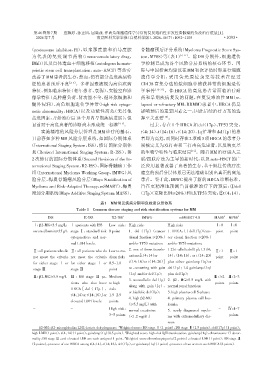
               (proteasome inhibitor,PI),以来那度胺和泊马度胺               骨髓瘤预后评分系统(Myeloma Prognostic Score Sys⁃
                为代表的免疫调节药物(immunomodulatory drug,                 tem,MPSS)等(表 1)       。除 ISS 分期外,细胞遗传
                                                                                    [6-11]
                IMiD)以及自体造血干细胞移植(autologous hemato⁃               学检测已成为各个风险分层系统的核心环节。国
                poietic stem cell transplantation,auto⁃HSCT)等治疗   际与中国指南均建议在MM初次评估时即进行细胞
                改善了MM患者的生存,然而,仍有部分高危疾病特                           遗传学分析,采用荧光原位杂交等技术在经过
                征的患者预后不良         [2-3] 。多种因素被视为高危疾病               CD138 富集分选的浆细胞中捕获异常的细胞遗传
                特征,例如临床特征(老年患者、衰弱)、实验室和影                          学事件   [12-13] 。伴 HRCA 的高危患者常面临治疗耐
                像学特征(高肿瘤负荷、肾功能不全、循环浆细胞和                           药和早期疾病复发的问题,在复发难治性 MM(re⁃

                髓外浸润)、高危细胞遗传学异常(high risk cytoge⁃                 lapsed or refractory MM,RRMM)患者中,HRCA 仍是
                netic abnormality,HRCA)以及功能性高危(无其他                影响预后的重要因素之一,因此后续治疗方案的选
                高危因素,开始治疗后18个月内早期疾病进展),但                          择至关重要 。
                                                                            [14]
                目前对于高危患者的诊断尚未形成统一标准                    [4-5] 。        过去,存在 1 个 HRCA 如 del(17p)、TP53 突变、
                    实施精准的风险分层管理是 MM 诊疗的基石,                        t (4;14)、t(14;16)、t(14;20)、1q扩增和del(1p)的患
                目前存在多种 MM 风险分层系统,如国际分期体系                          者即为高危,而同时存在2项或3项HRCA的患者分
               (International Staging System,ISS)、修订国际分期体         别被定义为双打击和三打击高危患者,以反映更差
                系(Revised International Staging System,R⁃ISS)、第   的生物学特性与临床结局            [15] 。随着MM治疗进入三

                2 次修订的国际分期体系(Second Revision of the In⁃           联/四联疗法为主导的新时代,以及 auto⁃HSCT 的广
                ternational Staging System,R2⁃ISS)、国际骨髓瘤工作        泛应用显著改善了患者的生存,基于既往传统疗法
                组(International Myeloma Working Group,IMWG)风      建立的预后分层体系已无法准确识别出真正的高危
                险分层、梅奥骨髓瘤风险分层(Mayo Stratification of              患者。鉴于此,IMWG提出了新的HRCA诊断标准,
                Myeloma and Risk⁃Adapted Therapy,mSMART)、梅奥       旨在更精准地预测当前标准治疗下的预后:①del
                附加分期系统(Mayo Additive Staging System,MASS)、       (17p)(克隆比例≥20%)和/或TP53突变;②t(4;14)、

                                               表1 MM常见疾病分期和危险度分层体系
                                    Table 1 Common disease staging and risk stratification systems for MM
                       ISS              R⁃ISS        R2⁃ISS 1     IMWG              mSMART 4.0      MASS 2  MPSS 3
                Ⅰ:β2⁃MG<3.5 mg/L; Ⅰ:patients with ISS  Low risk:High risk:    High risk:            Ⅰ:0    Ⅰ:0
                serumalbumin≥35 g/L stage Ⅰ,standard risk 0 point  1. del(17p)(cancer 1. HRCA:1.1 del(17p)(can⁃  point  point
                                  cytogenetics,and nor⁃     clonal fraction ≥20%) cer clonal fraction ≥20% )
                                  mal LDH levels.           and/or TP53 mutation; and/or TP53 mutation;
                                                            2. one of these translo⁃ 1.2 bi⁃allelic del(1p);1.3 t(4;
                Ⅱ:all patients who do Ⅱ:all patients who do Low to me⁃                              Ⅱ:1    Ⅱ:1
                not meet the criteria not meet the criteria dium risk:  cations[t(4;14)or  14),(14;16),or t(14;20)  point  point
                                                            t (14;16)or t(14;20)] plus either gain/amp(1q)or
                for either stage Ⅰ or for either stage Ⅰ or 0.5-1.0
                                                            co⁃occurring with gain del(1p);1.4 gain/amp(1q)
                stage Ⅲ           stage Ⅲ          point
                                                            (1q)and/or del(1p); plus del(1p);
                Ⅲ:β2⁃MG≥5.5 mg/L  Ⅲ :ISS stage Ⅲ pa⁃ Medium                                         Ⅲ:≥2 Ⅲ:2-3
                                                            3. monoallelic del(1p) 2. β2 ⁃ MG>5.5 mg/L with
                                  tients who also have to high                                      points  points
                                                            along with gain(1q),normal renal function;
                                  HRCA[ del( 17p ),risk:
                                                            or biallelic del(1p);  3. high plasma cell S⁃phase;
                                  t (4;14)or t(14;16)]or 1.5-2.5
                                                            4. high β2⁃MG     4. primary plasma cell leu⁃
                                  elevated LDH levels  points
                                                            (≥5.5 mg/L)with   kemia;
                -                 -                High risk:                                         -   Ⅳ:4-7
                                                            normal creatinine  5. newly diagnosed myelo⁃
                                                   3-5 points  (<1.2 mg/dL)   ma with extramedullary dis⁃  points
                                                                              ease
                   β2⁃MG:β2⁃microglobulin;LDH:lactate dehydrogenase. Weighted score:ISS stage Ⅱ(1 point),ISS stage Ⅲ(1.5 points),del(17p)(1 point),
                                                        1
                                                           2
                high LDH(1 point),t(4;14)(1 point),gain/amp(1q)(0.5 point). Weighted score:high⁃risk IgH translocation,gain/amp(1q),chromosome 17 abnor⁃
                                                          3
                mality,ISS stage Ⅲ,and elevated LDH are each assigned 1 point. Weighted score:thrombocytopenia(2 points),elevated LDH(1 point),ISS stage Ⅲ
               (2 points),presence of one HRCA among t(4;14),t(14;16),del(17p),or gain/amp(1q)(1 point),presence of two or more such HRCA(2 points).

