


Page 56 - 南京医科大学自然版
P. 56
第46卷第7期
               ·1002 ·                           南 京    医 科 大 学 学         报                        2026年7月


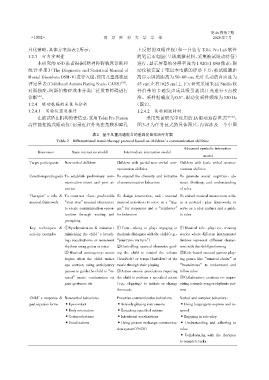
              异化策略,具体方案如表2所示。                                   上反射的双眼注视)和一台装有 Tobii Pro Lab 软件
              1.2.3 行为学测量                                       的笔记本电脑(呈现刺激材料、采集被试眼动特征)
                  本研究的ASD患者根据《精神障碍临床诊断和                         进行,显示屏幕的分辨率设为 1 920×1 080 像素;眼
              统计手册》(The Diagnostic and Statistical Manual of    动仪被安置于笔记本电脑的屏幕下方;被试眼睛距
              Mental Disorders,DSM⁃V)进行入组,使用儿童孤独症               离显示屏的距离为50~60 cm;允许头动的自由度为
                                                         [41]
              评定量表(Childhood Autism Rating Scale,CARS) ,        45 cm(左右)×25 cm(上下);研究采用Tobii Studio软
              对孤独症、阿斯伯格症或未分类广泛发育障碍进行                            件自带的卡通发声玩具吸引被试目光进行 5 点校
                  [42]
              诊断 。                                              准。采样精确度为 0.5°,眼动仪采样频率为 120 Hz
              1.2.4 眼动数据的采集与分析                                 (图2)。
              1.2.4.1 实验仪器及操作                                   1.2.4.2 实验刺激材料

                  在被试所在机构的评估室,采用Tobii Pro Fusion                     采用先前研究中使用的JA眼动追踪范式                  [43-45] 。
              高性能便携式眼动仪(记录近红外光在角膜和瞳孔                            图 3~5 为任务范式的具体图片,内容涉及一个中国

                                            表2 基于儿童沟通能力的差异化音乐治疗方案
                           Table 2 Differentiated music therapy protocol based on children’s communication abilities
                                                                                      Advanced symbolic interaction
                  Dimension       Basic interaction model  Intermediate interaction model
                                                                                               model
               Target participants  Non⁃verbal children  Children with partial non⁃verbal com⁃ Children with basic verbal commu⁃
                                                       munication abilities         nication abilities
               Coretherapeutic goals To establish preliminary com⁃ To expand the diversity and initiative To promote social cognition,ab⁃
                               municative intent and joint at⁃ of communicative behaviors  stract thinking,and understanding
                               tention                                              of rules
               Therapist’s role & To construct clear,predictable To design interactive,task ⁃ oriented To embed musical interactions with⁃
               musical framework  “start⁃stop”musical structures;musical activities;to serve as a“trig⁃ in a pretend ⁃ play framework;to
                               to create communication oppor⁃ ger”for responses and a“reinforcer” serve as a play partner and a guide
                               tunities through waiting and for behaviors           to rules
                               prompting
               Key techniques & ①Synchronization & imitation:① Turn ⁃ taking in play:engaging in ① Musical role ⁃ play:co ⁃ creating
               activity examples  mimicking the child’s breath⁃ rhythmic dialogues with the child(e.g.,stories where different instruments/
                               ing,vocalizations,or movement “your turn,my turn”)   timbres represent different charac⁃
                               rhythms using guitar or voice  ②Controlling musical elements:guid⁃ ters,with the child performing
                               ② Musical contingency:music ing the child to control the volume ②Rule⁃based musical games:play⁃
                               begins when the child makes (loud/soft)or tempo(fast/slow)of the ing games like“musical chairs”or
                               eye contact;using anticipatory music through their playing  “freeze/move” to understand and
                               pauses to guide the child to“re⁃ ③Action⁃music association:requiring follow rules
                               quest” music continuation via the child to perform a specified action ③Collaborative creation:co⁃impro⁃
                               gaze,gestures,etc      (e.g.,clapping)to initiate or change vising a simple song or rhythmic pat⁃
                                                       the music                    tern
               Child’s response & Non⁃verbal behaviors:  Proactive communicative behaviors:  Verbal and complex behaviors:
               participation forms  •Eye contact       •Actively playing instruments  •Using language to express and re⁃
                               •Body orientation       •Executing specified actions  spond
                               •Gestures/actions       •Intentional vocalizations   •Engaging in role⁃play
                               •Vocalizations          •Using picture exchange communica⁃ • Understanding and adhering to
                                                       tion system(PECS)            rules
                                                                                    • Collaborating with the therapist
                                                                                    to complete tasks

