


Page 125 - 南京医科大学自然版
P. 125
第45卷第2期                  赵翔宇,姚心怡,孙美玲. 慢性肾脏病诱导认知障碍的研究进展[J].
                  2025年2月                     南京医科大学学报(自然科学版),2025,45(2):260-270                        ·265 ·


                受体(AT2R)并发挥生理作用的主要效应分子                    [25] 。  间的相互作用。这种相互作用导致神经血管单元
                AT1R广泛分布于脑组织中,如BBB周围、下丘脑室                         的结构改变和功能受损,引发 BBB 破坏、神经胶质
                上核和室旁核等 ,而AT2R在下橄榄、丘脑核和内                          反应和免疫细胞浸润等一系列生理和病理变化,最
                              [26]
                                             [27]
                侧膝状核等核团的分布密度较高 。尽管AngⅡ能                           终导致 CI(表 1)。当尿毒症毒素渗透到脑中,会对
                够结合两种不同的受体,但ACE的上调会使AT1R特                         脑内细胞如神经元、胶质细胞等产生有害影响,导
                异性增加,进而加剧脑内炎症、细胞死亡及CI。CKD                         致工作记忆损伤、突触可塑性受损,影响认知功
                患者体内增加的Ang Ⅱ激活其受体AT1R,导致BBB                       能。尿酸、IS和甲基胍胺等可直接刺激脊髓上段腹
                破坏,使得循环毒素得以进入脑。这一过程触发小胶                           侧中央区的神经元,通过增加氧化应激引起直接的
                质细胞的过度激活,促使其从保护性的M2表型向炎                           神经毒性作用。甲基乙二醛(methylglyoxal,MGO)

                症性的M1表型转变,伴随着NOS水平的上升和ROS                         和吲哚乙酸(indole⁃3⁃acetic acid,IAA)能够降低小
                及促炎细胞因子的产生,如TNF⁃α、IL⁃1β和IL⁃6,导致                   鼠海马神经元细胞系HT⁃22的存活率,而这与谷胱
                神经元损伤。此外,Ang Ⅱ通过增强脑内皮细胞上的                         甘肽水平降低有着密切联系              [28] 。尿毒症毒素除了
                AT1R活性,进一步增加BBB的渗透性,形成正反馈                         对神经元有直接神经毒性作用,对胶质细胞也产生
                循环,加剧神经损伤,最终可能导致CI的发生。这些                          影响。甲基胍可能通过增强凋亡反应和改变胶质
                发现揭示了RAS系统在CKD相关CI中的潜在作用,                         细胞线粒体钙稳态来促进神经退行性变                    [29] 。星形
                并为未来的治疗策略提供了可能的干预靶点。                              胶质细胞在CNS中具有多种关键功能,但其暴露于
                2.2 神经性变性                                         IS 后可导致糖酵解抑制和细胞凋亡,并激活 NF⁃
                2.2.1 尿毒症毒素的直接神经毒性                                κB 和 AhR 导致炎症反应和氧化应激             [30] 。活性炭吸
                    据报道,部分尿毒症毒素能够介导肾脏和脑之                          附剂 AST⁃120 能显著降低血清和脑 IS 水平,改善海

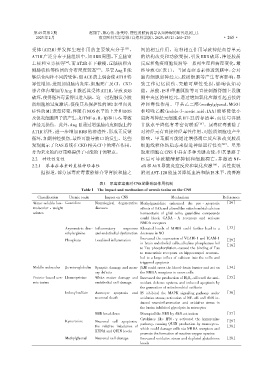
                                               表1 尿毒症毒素对CNS的影响及作用机制
                                      Table 1 The impact and mechanism of uremic toxins on the CNS
                  Classification  Uremic toxin   Impact on CNS                  Mechanism               References
                Water⁃soluble low⁃ Guanidine  Neurological degenerative Methylguanidine enhanced the pro ⁃ apoptotic  [29]
                molecular ⁃ weight           diseases             effects of H2O2 and altered the mitochondrial calcium
                solutes                                           homeostasis of glial cells;guanidine compounds
                                                                  could block GABA ⁃ A receptors and activate
                                                                  NMDA receptors
                                                                                                         [33]
                               Asymmetric dim⁃ Inflammatory  responses Elevated levels of ADMA could further lead to a
                               ethylarginine  and endothelial dysfunction decrease in NO
                                                                  Increased the expression of VCAM⁃1 and ICAM⁃1
                               Phosphate     Localized inflammation                                      [29]
                                                                  in brain endothelial cells;alkaline phosphatase led
                                                                                                         [16]
                                                                  to Tau phosphorylation,caused the binding of Tau
                                                                  to muscarinic receptors on hippocampal neurons,
                                                                  led to a large influx of calcium into the cells and
                                                                  triggered apoptosis
                Middle molecules  β2⁃microglobulin  Synaptic damage and mem⁃ β2M could cross the blood⁃brain barrier and act on  [34]
                                             ory deficits         the NMDA receptors in nerve cells
                Protein⁃bound ure⁃ Homocysteine  White matter damage and Increased the production of H 2O2,affected the anti⁃  [35]
                mic toxins                   endothelial cell damage  oxidant defense system,and induced apoptosis by
                                                                  the generation of mitochondrial oxidants
                               Indoxyl sulfate  Astrocyte  apoptosis  and IS inhibited the MAPK signaling pathway under  [36]
                                             neuronal death       oxidative stress;activation of NF⁃κB and AhR in⁃
                                                                  duced neuroinflammation and oxidative stress in
                                                                  the brain;inhibited glycolysis in astrocytes
                                             BBB breakdown        Disrupted the BBB by AhR activation    [37]
                                                                  Cytokines like IFN ⁃ γ activated the kynurenine
                               Kynurenine    Neuronal cell apoptosis;                                    [29]
                                                                  pathway,causing QUIN production by monocytes,
                                             the relative imbalance of                                   [38]
                                                                  which could damage cells via NMDA receptors and
                                             KYNA and QUIN levels
                                                                  promote the formation of reactive oxygen species
                               Methylglyoxal  Neuronal cell damage  Increased oxidative stress and depleted glutathione  [28]
                                                                  levels

