


Page 39 - 南京医科大学自然版
P. 39
第46卷第4期         任琼迪,苏凯奇,张 铭. 氨基酸代谢紊乱在卒中后认知障碍中的作用机制及研究进展[J].
                  2026年4月                    南京医科大学学报(自然科学版),2026,46(4):499-511,519                     ·507 ·


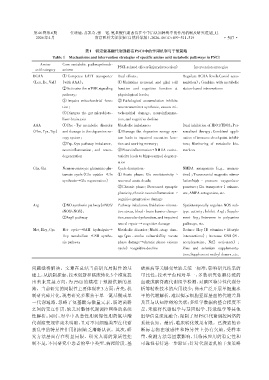
                                        表1 特定氨基酸代谢通路在PSCI中的作用机制与干预策略
                         Table 1 Mechanisms and intervention strategies of specific amino acid metabolic pathways in PSCI
                    Amino     Core metabolic pathways/mech⁃
                                                       PSCI⁃related effects(injury/protection)  Intervention strategies
                 acid category  anisms
                BCAA          ① Competes LAT1 transporter  Dual effects:             Regulate BCAA levels(avoid accu⁃
                (Leu,Ile,Val) (with AAA);              ① Maintains neuronal and glial cell  mulation);Combine with metabolic
                              ②Activates the mTOR signaling  function and cognitive function at  status⁃based interventions
                              pathway;                 physiological levels;
                              ③ Impairs mitochondrial func⁃  ② Pathological accumulation inhibits
                              tion;                    neurotransmitter synthesis,causes mi⁃
                              ④ Disrupts the gut microbiota ⁃  tochondrial damage,neuroinflamma⁃
                              liver⁃brain axis         tion,and cognitive decline
                AAA           ① Phe ⁃ Tyr metabolic disorder  Metabolic imbalance:   Dual inhibition of IDO1/TDO2;Per⁃
                (Phe,Tyr,Trp) and damage to the dopamine en⁃  ① Damage the dopamine energy sys⁃  sonalized therapy;Combined appli⁃
                              ergy system;             tem leads to impaired executive func⁃  cation of immune checkpoint inhibi⁃
                              ②Trp⁃Kyn pathway imbalance, tion and working memory;   tors;Monitoring of metabolic bio⁃
                              neuroinflammation,and neuro⁃  ②Neuroinflammation+NMDA excito⁃  markers
                              degeneration             toxicity leads to hippocampal degener⁃
                                                       ation
                Glu,Gln       Neuron⁃astrocyte glutamine⁃glu⁃  Cycle disruption:     NMDA antagonists (e.g.,meman⁃
                              tamate cycle(Glu uptake→Gln  ① Acute phase:Glu excitotoxicity→  tine);Transcranial magnetic stimu⁃
                              synthesis→Glu regeneration)  neuronal acute death;     lation/high ⁃ pressure oxygen/acu⁃

                                                       ②Chronic phase:Decreased synaptic  puncture;Glu transporter 1 enhanc⁃
                                                       plasticity,chronic neuroinflammation→  ers,AMPA antagonists,etc.
                                                       cognitive progressive damage
                Arg           ①NO synthesis pathway(nNOS/  Pathway imbalance:Oxidative⁃nitrosa⁃  Spatiotemporally regulate NOS sub⁃
                              iNOS/eNOS);              tive stress,blood ⁃ brain barrier disrup⁃  type activity;Inhibit Arg1;Supple⁃
                              ②Arg1 pathway            tion,vascular dysfunction,and impaired  ment Arg;Intervene in polyamine
                                                       neural repair → cognitive damage  pathways,etc.
                Met,Hcy,Cys   Met cycle→SAH hydrolysis→  Metabolic disorder:Multi ⁃ stage dam⁃  Reduce Hcy(B vitamins + lifestyle
                              Hcy metabolism→GSH synthe⁃  age(pre ⁃ stroke vulnerability→acute  interventions);Increase GSH(N ⁃
                              sis pathway              phase damage→chronic phase vicious  acetylcysteine,Nrf2 activators) ;
                                                       cycle)→cognitive decline      Zinc and selenium supplementa⁃
                                                                                     tion;Supplement methyl donors,etc.


                问题亟待解决。文章在总结当前研究局限性的基                             础疾病等关键变量缺乏统一标准,影响研究结果的
                础上,从机制探索、技术创新和临床转化3个维度提                           可比性;技术平台相对单一,多数研究依赖传统的
                出未来发展方向,为 PSCI 的精准干预提供新的思                         血液或脑脊液代谢组学检测,对脑区特异性代谢分
                路。当前研究的局限性主要体现在3方面:首先,机                           析等精准技术的应用较少;尚未广泛开展单细胞水
                制研究碎片化,现有研究多聚焦于单一氨基酸或单                            平的代谢解析,难以揭示细胞亚群层面的代谢差异
                一代谢通路,忽略了氨基酸与微量元素、肠道菌群                            及其与认知障碍的关联;多组学数据的整合程度不
                之间的交互作用,缺乏对整体代谢调控网络的系统                            足,未能将代谢组学与基因组学、转录组学等其他
                性解析;同时,对卒中从急性期到慢性期的氨基酸                            组学信息深度融合,限制了对PSCI代谢调控网络的
                代谢演变规律尚未明确,且对不同细胞类型在代谢                            系统认知。最后,临床转化效果有限。已探索的诊
                紊乱中的特异性作用机制缺乏清晰认识。其次,研                            断标志物在敏感性和特异性上仍有欠缺,受样本
                究方法层面存在明显局限。研究人群的异质性控                             量、检测方法等因素影响,其临床应用的稳定性和
                制不足,不同研究中患者的卒中类型、病程阶段、基                           可靠性有待进一步验证;针对代谢紊乱的干预策略

