


Page 89 - 南京医科大学自然版
P. 89
第46卷第4期           李皓阳,钱芷君,曾嘉欣,等. 肥胖减弱心力衰竭患者标准药物治疗后的心脏逆重构[J].
                  2026年4月                      南京医科大学学报(自然科学版),2026,46(4):551-560                       ·557 ·


                A                                B                               C
                                                       Model 1:baseline(AUC=0.792)      Model 1:baseline(AUC=0.772)
                       Model 1:baseline(AUC=0.782)     Model 2:Model 1+BMI(AUC=0.87)    Model 2:Model 1+BMI(AUC=0.863)
                       Model 2:Model 1+BMI(AUC=0.874)  Model 3:Model 2+LGE(AUC=0.893)   Model 4:Model 2+ECV(AUC=0.923)
                   1.0                              1.0                              1.0
                   0.8                              0.8                              0.8
                   Sensitivity  0.6                Sensitivity  0.6  Model 2 vs Model 3:  Sensitivity  0.6  Model 2 vs Model 4:

                                                                                     0.4
                                                    0.4
                   0.4
                                                                 P=0.272                          P=0.162
                   0.2                              0.2                              0.2
                             Model 1 vs Model 2:                 Model 1 vs Model 3:              Model 1 vs Model 4:
                             P=0.178                             P=0.126                          P=0.043
                     0                               0                                0
                         00  0.2 0.4 0.6 0.8 1.0         00  0.2 0.4 0.6 0.8 1.0          00  0.2 0.4 0.6 0.8 1.0
                              1-Specificity                   1-Specificity                    1-Specificity
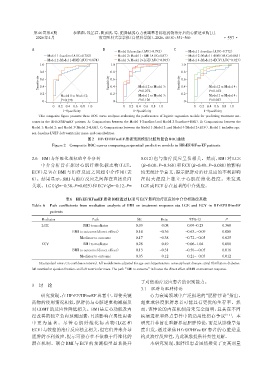
                   This composite figure presents three ROC curve analyses evaluating the performance of logistic regression models for predicting treatment out⁃
                comes in the HFrEF/HFmrEF patients. A:Comparations between the Model 1(baseline)and Model 2(baseline+BMI). B:Comparations between the
                Model 1,Model 2,and Model 3(Model 2+LGE). C:Comparations between the Model 1,Model 2,and Model 4(Model 2+ECV). Model 1 includes age,
                sex,baseline LVEF,left ventricular mass,and comorbidities.
                                         图2 HFrEF/HFmrEF患者预测模型比较的复合ROC曲线
                         Figure 2 Composite ROC curves comparing sequential predictive models in HFrEF/HFmrEF patients


                2.6 BMI与纤维化指标的中介分析                                0.012)也与治疗反应呈负相关。然而,BMI 对 LGE
                    中介分析旨在探讨心肌纤维化标志物(LGE、                        (β=0.08,P=0.368)和 ECV(β=0.49,P=0.088)的影响
                ECV)是否在 BMI 与治疗反应之间起中介作用(表                        均无统计学意义,提示肥胖对治疗反应的不利影响
                6)。结果显示,BMI 与治疗反应之间存在直接负向                         在很大程度上独立于心肌纤维化程度。未发现
                关联。LGE(β=-0.38,P=0.025)和 ECV(β=-0.12,P=           LGE或ECV存在显著的中介效应。


                               表6 HFrEF/HFmrEF患者BMI通过LGE与ECV影响治疗反应的中介分析路径系数
                Table 6  Path coefficients from mediation analysis of BMI on treatment response via LGE and ECV in HFrEF/HFmrEF
                        patients

                    Mediator                Path                SE         Beta         95% CI           P
                    LGE                BMI to mediator          0.09       -0.08       -0.09-0.25       0.368
                                  BMI to outcome(direct effect)  0.14      -0.36       -0.63--0.09      0.008
                                      Mediator to outcome       0.17       -0.38       -0.72--0.05      0.025
                    ECV                BMI to mediator          0.28       -0.49       -0.06-1.04       0.088
                                  BMI to outcome(direct effect)  0.13      -0.31       -0.56--0.05      0.018

                                      Mediator to outcome       0.05       -0.12       -0.21--0.03      0.012
                   SE:standard error;CI:confidence interval. All models were adjusted for age,sex,hypertension,coronary heart disease,atrial fibrillation,diabetes,
                left ventricular ejection fraction,and left ventricular mass. The path“BMI to outcome”indicates the direct effect of BMI on treatment response.

                                                                  了对低治疗反应患者的识别能力。
                3  讨 论
                                                                  3.1  肥胖与肥胖悖论
                    研究发现,在HFrEF/HFmrEF患者中,即使关键                        心力衰竭领域中广泛报道的“肥胖悖论”指出,
                药物的使用情况相似,肥胖仍与心脏逆重构减弱及                            超重或轻度肥胖患者可能具有更优的生存率。然
                对GDMT的反应性降低相关。BMI是左心功能及内                          而,该悖论的内在机制尚未完全阐明,且其在不同
                径改善的独立负向预测因素,且该影响在男性患者                            疾病进程和终点事件中的适用性仍存争议                     [5-6] 。本
                中更为显著。尽管心肌纤维化标志物(LGE 和                            研究并非旨在重新界定肥胖悖论,而是从影像学角
                ECV)与较差的治疗反应独立相关,但它们并未介导                          度出发,通过聚焦 HFrEF/HFmrEF 患者的心脏逆重
                肥胖的不利效应,提示可能存在不依赖于纤维化的                            构及治疗反应性,为此现象提供补充性见解。
                潜在机制。联合 BMI 与 ECV 的预测模型显著提升                           本研究发现,肥胖组患者虽然接受了更高剂量

