


Page 109 - 南京医科大学自然版
P. 109
第46卷第6期            屈 越,蒋梦婷,吕 红,等. 婴儿期条栅视力与3岁神经发育的前瞻性队列研究[J].
                  2026年6月                      南京医科大学学报(自然科学版),2026,46(6):885-893                      ·891  ·


                CI:1.25~4.72)、在排除低出生体重儿后增加 115%                       本研究中,条栅视力异常界值为3.89 cpd,该数
               (RR=2.15,95%CI:1.13~4.08),在排除辅助生殖受                 值与既往研究报道的 12 个月龄婴儿条栅视力参考
                孕出生的儿童后增加169%(RR=2.69,95%CI:1.37~                 水平较为接近。已有一项针对中国婴儿条栅视力
                5.28),而其余神经发育维度未见统计学显著关联。                         参考标准的前瞻性研究显示,12个月龄婴儿的条栅
                                                                                    [18]
                                                                  视力均值为 3.73 cpd       。此外,另一项荟萃分析更
                3  讨 论
                                                                  新了 TAC Ⅱ的年龄特异性参考标准,指出约 12 个
                    本研究基于江苏出生队列,纵向分析了婴儿期                          月龄婴儿单眼条栅视力的正常下限为 3.75 cpd                 [15] 。
                条栅视力与 3 岁神经发育的关联,发现婴儿期条栅                          若采用上述研究中的条栅视力下限作为异常划分
                视力异常与 3 岁大运动发育欠佳风险增加相关,在                          依据,视力异常的分类结果未发生变化。
                排除双胎、早产儿、低出生体重儿及辅助生殖受孕                                已有研究探讨了视力异常对认知能力、运动能
                出生的儿童后,该关联仍然显著。这表明婴儿期条                            力的负面影响       [19-22] ,本研究与既往发现一致。一项
                栅视力异常可能是影响3岁神经发育的大运动维度                            观察性横断面研究对1~42个月龄儿童分析发现,条
                的危险因素。                                            栅视力水平与基于BSID⁃Ⅲ评估的认知和运动评分


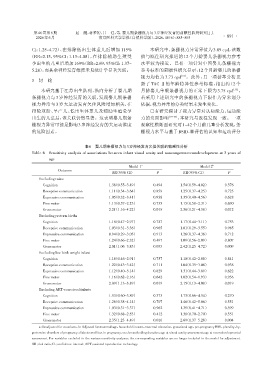
                                        表6 婴儿期条栅视力与3岁神经发育欠佳关联的敏感性分析
                Table 6  Sensitivity analysis of associations between infant visual acuity and noncompetentneurodevelopment at 3 years of
                        age

                                                             Model 1 a                       Model 2 b
                            Outcome
                                                     RR(95% CI)          P            RR(95% CI)          P
                   Excluding twins
                     Cognition                     1.38(0.55-3.49)      0.494       1.54(0.59-4.02)      0.376
                     Receptive communication       1.11(0.34-3.64)      0.859       1.25(0.37-4.25)      0.725
                     Expressive communication      1.05(0.32-3.41)      0.938       1.35(0.40-4.56)      0.628
                     Fine motor                    1.13(0.57-2.23)      0.735       1.15(0.58-2.31)      0.690
                     Gross motor                   2.21(1.16-4.22)      0.015       2.36(1.21-4.58)      0.012
                   Excluding preterm births
                     Cognition                     1.18(0.47-2.97)      0.727       1.17(0.44-3.11)      0.753
                     Receptive communication       1.03(0.31-3.36)      0.965       1.01(0.29-3.55)      0.985
                     Expressive communication      0.94(0.29-3.05)      0.913       1.26(0.37-4.36)      0.712
                     Fine motor                    1.24(0.66-2.32)      0.497       1.09(0.56-2.09)      0.807
                     Gross motor                   2.01(1.06-3.83)      0.033       2.42(1.25-4.72)      0.009
                   Excluding low birth weight infant
                     Cognition                     1.16(0.46-2.91)      0.757       1.10(0.42-2.88)      0.841
                     Receptive communication       1.22(0.43-3.42)      0.711       1.04(0.35-3.08)      0.938
                     Expressive communication      1.12(0.40-3.14)      0.829       1.31(0.44-3.89)      0.622
                     Fine motor                    1.16(0.62-2.16)      0.642       1.02(0.54-1.93)      0.956
                     Gross motor                   2.09(1.13-3.89)      0.019       2.15(1.13-4.08)      0.019
                   Excluding ART⁃conceived infants
                     Cognition                     1.53(0.60-3.89)      0.373       1.73(0.66-4.54)      0.270
                     Receptive communication       1.26(0.38-4.14)      0.707       1.46(0.42-5.06)      0.551
                     Expressive communication      1.03(0.31-3.37)      0.962       1.39(0.41-4.71)      0.599
                     Fine motor                    1.32(0.68-2.53)      0.412       1.38(0.70-2.70)      0.351
                     Gross motor                   2.35(1.23-4.49)      0.010       2.69(1.37-5.28)      0.004
                   a:Unadjusted for covariates. b:Adjusted for maternal age,household income,maternal education,gestational age,pre⁃pregnancy BMI,plurality,hy⁃
                pertensive disorders of pregnancy,diabetes mellitus in pregnancy,sex,breastfeeding duration,age at visual acuity assessment,age at neurodevelopmental
                assessment. For variables excluded in the various sensitivity analyses,the corresponding variables are no longer included in the model for adjustment.
                RR:risk ratio;CI:confidence interval;ART:assisted reproductive technology.

