


Page 134 - 南京医科大学自然版
P. 134
第45卷第12期
               ·1816 ·                           南 京    医 科 大 学 学         报                        2025年12月


              SphK1选择性抑制剂(如PF⁃543)可显著降低S1P生                     非脂质小分子,可同时抑制SphK1和SphK2的活性,
              成,有效缓解心肌结构和功能损伤                [59] 。该作用机制        并通过诱导 SphK1 的溶酶体依赖性降解,有效降低
              涉及下调α⁃平滑肌肌动蛋白与Ⅰ型胶原的表达,从                           细胞内S1P水平。已有研究表明,SKI⁃II在调节心肌
              而减轻心肌纤维化,改善心脏功能,提示其在微循                            细胞凋亡、抑制纤维化以及改善内皮功能方面具有
              环保护与抗纤维化治疗中的潜在应用价值                     [59] 。除    多靶点作用,展现出其在心血管疾病,特别是微循
                                                                                       [61]
              了 PF⁃543 等 SphK1 特异性抑制剂外,SKI⁃II 是一种               环障碍干预中的潜在价值 。
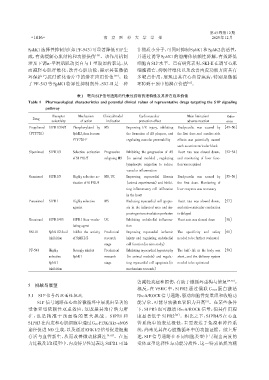
                                     表1 靶向S1P信号通路的代表性药物药理特性及其潜在临床价值
              Table 1  Pharmacological characteristics and potential clinical values of representative drugs targeting the S1P signaling
                      pathway

                         Receptor    Mechanism  Clinical/model   Cardiovascular        Main limitation/   Refer⁃
                Drug
                         selectivity  of action   indication     protection effect     adverse reaction   ence
              Fingolimod  S1PR1/3/4/5  Phosphorylated by  MS  Improving I/R injury,inhibiting  Bradycardia was caused by  [49-50]
              (FTY720)             SphK2,then become       the formation of AS plaques,and  the first dose and cardiac side
                                   FTY720⁃P                regulating vascular permeability  effects was potentially caused
                                                                                   such as atrioventricular block
              Siponimod  S1PR1/5   Selective activation  Progressive  Inhibiting the progression of AS  Heart rate was slowed down,  [52-54]
                                   of S1PR1/5    relapsing MS  (in animal models),regulating  and monitoring of liver func⁃
                                                           lymphocyte migration to reduce  tion was required
                                                           vascular inflammation
              Ozanimod  S1PR1/5    Highly selective ac⁃  MS,UC  Improving  myocardial  fibrosis  Bradycardia was caused by  [55-56]
                                   tivation of S1PR1/5     (animal experiments)and inhibi⁃  the first dose. Monitoring of
                                                           ting inflammatory cell infiltration  liver enzymes was necessary
                                                           in the heart
              Ponesimod  S1PR1     Highly selective  MS    Reducing myocardial cell apopto⁃  Heart rate was slowed down,  [57]
                                   agonist                 sis in the infarcted area and im⁃  and atrioventricular conduction
                                                           proving microcirculation perfusion  is delayed
              Etrasimod  S1PR1/4/5  S1PR1 bias⁃modu⁃  UC   Inhibiting endothelial inflamma⁃  Heart rate was slowed down  [58]
                                   lating agent            tion
              SKI⁃II    SphK1/2 dual  Inhibit the activity  Preclinical  Improving myocardial ischemic  The specificity and safety  [61]
                        inhibition  of SphK1/2   research  injury and regulating endothelial  needed to be further evaluated
                                                 stage     cell function(in vitro study)
              PF⁃543    Highly     Strongly inhibit  Preclinical  Inhibiting myocardial hypertrophy  The half⁃life in the body was  [59]
                        selective  SphK1         research  (in animal models)and regula ⁃  short,and the delivery system
                        SphK1                    stage     ting myocardial cell apoptosis(in  needed to be optimized
                        inhibition                         mechanism research)

                                                                著减轻炎症和损伤,有助于微循环重构与修复                     [39,63] 。
              5 挑战与展望
                                                                相反,在 VSMC 中,S1PR2 通过偶联 G12/13 蛋白激活
              5.1  S1P信号的双面性挑战                                  RhoA/ROCK信号通路,驱动细胞骨架重组和收缩功
                                                                                               [9]
                  S1P 信号通路在心血管微循环中展现出显著的                        能异常,可能导致微血管阻力升高 。在某些条件
              受体亚型依赖性双重效应,这既是其治疗潜力所                             下,S1PR3 也可激活 RhoA/ROCK 信号,但其作用程
              在 ,也 是 精 准 干 预 面 临 的 重 大 挑 战 。 S1PR1 和            度显著低于 S1PR2      [64] 。相比之下,S1PR4/5 在心血

              S1PR3在内皮和心肌细胞中通过Gi/o⁃PI3K/Akt⁃eNOS                管系统中的表达极低,主要表达于免疫和神经系
              途径促进 NO 生成,以及通过ERK1/2信号促进细胞                       统,尚未见其在心脏微循环中的功能证据。综上所
              存活与血管新生,从而改善微动脉灌注                   [8,62] 。在压    述,S1P 信号通路在不同细胞类型中呈现出高度的
              力过载及I/R模型中,内皮特异性过表达 S1PR1 可显                      受体亚型选择性与功能异质性,这一特点虽然为精

