


Page 143 - 南京医科大学自然版
P. 143
第46卷第10期                 陈奕文,张静静,张雄飞. 谷氨酰胺代谢和肿瘤耐药机制研究进展[J].
                 2026年10月                    南京医科大学学报(自然科学版),2026,46(10):1567-1583                     ·1573 ·


                                                                    Cystine
                                              AA                           Glu
                          Gln                                                               Gln
                                                     SLC7A8
                                                                           SLC7A11
                                SLC1A5
                                                                                              SLC38A5
                                                              Cystine
                                                                      Glu
                                                  AA
                                                                                           Na +
                                                               Cysteine                Gln
                                Gln               mTORC1
                                                        Proteasome
                                       GLS1
                                                                           NRF2
                                Gln           Glu               GSH                            Ferroptosis
                                                                                        ROS
                                                                           GPX4                inhibition
                            SLC1A5_var
                                                   ATP                Induced
                                                                      damage
                                         TCA
                                         circle
                          iMQT⁃020  Gln              ROS
                                            α⁃KG
                                                                                         PD⁃1/PD⁃L1
                                                                                         antibodies
                                    Mitochondria  Deficient
                                                                              PD⁃L1
                                                                    Demethylation      Anti⁃tumor immunity
                                                    TET
                                                                PD⁃L1
                                                    Nucleus
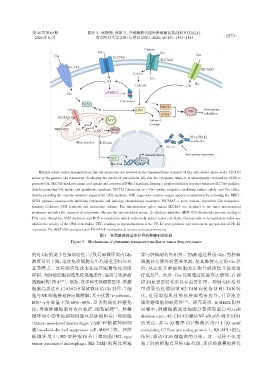
                   Multiple solute carrier transporters on the cell membrane are involved in the transmembrane transport of Gln and related amino acids. SLC1A5
                serves as the primary Gln transporter,facilitating the uptake of extracellular Gln into the cytoplasm,where it is subsequently catalyzed by GLS1 to
                generate Gln. SLC7A8 mediates amino acid uptake and activates mTORC1 signaling,forming a positive feedback loop that enhances SLC7A8 stability,
                thereby promoting Gln uptake and glutathione synthesis. SLC7A11 functions as a Gln⁃cystine antiporter,mediating cystine uptake and Glu efflux,
                thereby providing the cysteine substrate required for GSH synthesis. GSH suppresses reactive oxygen species accumulation by activating the NRF2⁃
                GPX4 pathway,consequently inhibiting ferroptosis and inducing chemotherapy resistance. SLC38A5,a novel sodium ⁃ dependent Gln transporter,
                similarly facilitates GSH synthesis and antioxidant defense. The mitochondrial splice variant SLC1A5_var,localized to the inner mitochondrial
                membrane,mediates the transport of cytoplasmic Gln into the mitochondrial matrix. Its allosteric inhibitor,iMQT⁃020,blocks this process,leading to
                TCA cycle disruption,GSH depletion,and ROS accumulation,which collectively induce tumor cell death. Concurrently,α⁃ketoglutarate deficiency
                inhibits the activity of the DNA demethylase TET,resulting in hypomethylation of the PD⁃L1 gene promoter and subsequent upregulation of PD⁃L1
                expression. The iMQT⁃020 synergizes with PD⁃1/PD⁃L1 antibodies to activate anti⁃tumor immunity.
                                               图3 谷氨酰胺转运体介导的肿瘤耐药机制
                                  Figure 3 Mechanisms of glutamine transporter⁃mediated tumor drug resistance


                的对Gln的竞争性摄取特性,导致局部微环境内Gln                         常与肿瘤耐药性相关。TAM 通过释放 Gln,为肿瘤
                浓度显著下降,迫使免疫细胞发生代谢重塑以应对                            细胞补充额外的营养来源,使其维持充足的 Gln 供
                营养匮乏。这种适应性改变往往伴随着免疫功能                             给,从而提升肿瘤细胞的生物合成活性并促进治
                                                                        [1]
                抑制,为肿瘤细胞创造免疫逃逸条件,进而导致肿瘤                           疗抵抗 。此外,Gln 代谢通过促进 TCA 循环,在调
                             [15]
                细胞耐药(图4) 。例如,在多种实体瘤模型中,肿瘤                         控 TAM 表型转化中具有重要作用。抑制 GLS 活性
                细胞高表达 SLC1A5/GLS 导致微环境 Gln 耗尽,T 细                 可诱导免疫抑制型 M2⁃TAM 向促炎型 M1⁃TAM 转
                胞与NK细胞被迫转向糖酵解,其干扰素(interferon,                    化,进而增强机体的抗肿瘤免疫应答,并可能克
                IFN)⁃γ分泌量下降 60%~80%,显著削弱抗肿瘤免                      服肿瘤细胞的耐药性          [41] 。研究表明,在 HER2 阳性
                疫,导致肿瘤细胞对吉西他滨、顺铂耐药 。肿瘤                            胃癌中,肿瘤细胞通过细胞分裂周期蛋白 42(cell
                                                     [9]
                微环境中的免疫抑制细胞包括肿瘤相关巨噬细胞                             division cycle 42,CDC42)激活NF⁃κB p65,调节GLS1
               (tumor⁃associated macrophage,TAM)和髓源抑制细            的表达,并与 IQ 基序 GTP 酶激活蛋白 1(IQ motif
                胞(myeloid⁃derived suppressor cell,MDSC)等。在肿       containing GTPase activating protein 1,IQGAP1)相互

                瘤微环境中,M2 型肿瘤相关巨噬细胞(M2⁃type                        作用,驱动 GLS1 微囊泡的分泌。这一过程不仅增
                tumor⁃associated macrophage,M2⁃TAM)的高比例通          强了肿瘤细胞自身的 Gln 代谢,还借助微囊泡将代

