


Page 145 - 南京医科大学自然版
P. 145
第46卷第10期                 陈奕文,张静静,张雄飞. 谷氨酰胺代谢和肿瘤耐药机制研究进展[J].
                 2026年10月                    南京医科大学学报(自然科学版),2026,46(10):1567-1583                     ·1575 ·


                观遗传机制,能够导致肿瘤细胞对化疗药物耐药。                            通过增强核苷酸代谢,补充因5⁃FU抑制而减少的核
                3.6  Gln代谢与DNA损伤修复                                苷酸池,从而维持 DNA 合成和修复的正常进行,这
                    肿瘤细胞能够通过提升核苷酸代谢水平以及                           种代谢重编程使得肿瘤细胞能够抵抗 5⁃FU 的毒性
                DNA 损伤修复能力,抵御化疗药物或放疗引发的                           作用,进而发展耐药性          [50] 。顺铂耐药细胞对营养匮
                DNA损伤,进而促使耐药性形成。核苷酸代谢是细                           乏的敏感性与其对 Gln 的显著依赖性密切相关,即
                胞合成 DNA 和 RNA 的基础,其代谢过程涉及多种                       在营养匮乏条件下,这些细胞更容易死亡,原因在
                酶和代谢途径。5⁃氟尿嘧啶(5⁃fluorouracil,5⁃FU)是               于它们高度依赖Gln以维持生存和生长。而在某些
                一种经典的抗代谢药物,主要用于治疗结直肠癌等                            顺铂耐药肿瘤细胞中,Gln 主要通过参与核苷酸的
                肿瘤,在某些结直肠癌细胞中,Gln代谢增强通过提                          生物合成途径发挥作用,而非参与TCA循环或氧化
                供更多的代谢中间体,支持核苷酸代谢的进行,并                            还原反应。Obrist等      [51] 研究表明,补充Gln可以挽救


                                                                    Resistance to
                                                                    glutaminease
                                                                    inhibitors(e.g.,CB⁃839)
                                                       Cystine
                            NK Cell
                                                                            Gln
                                            Gln
                                                                              SLC1A5
                                                                                                M2⁃TAM
                                  Glutamine            Cysteine  GSH
                                  competition
                                           SLC1A5
                                                                                       GLS1
                                                  Gln                  CDC42
                          Reduced                             Activate              Microvesicles
                                                   GLS1
                          IFN⁃γ and
                                       Glutamine
                          immune                                      NF⁃κB p65
                                       depletion  Glu                                    IL⁃6
                          suppression
                                                                       IQGAP1
                                                        GSH
                                                                              Activate
                                                  TCA                  STAT3
                                                  cycle
                                                              GLS1
                                                        ROS                                 Ras pathway
                                                                Mitochondrial                              CAF
                                                        balence                 Gln
                                           ATP                                                  PYCR1
                                                                OXPHOS
                           T cell
                                                                       Metabolic
                                      CD39
                           A2A                                                  Lactate
                                                                       coupling
                           recceptor  CD73
                  Inhibit                                     Oxidative
                  T cell                                      phosphorylation
                                                                                                  Collagen
                  activation  Adenosine
                                                                     Drugs
                  and
                  proliferation
                                                                                    ECM stiffening
                                                                                    (drug barrier)
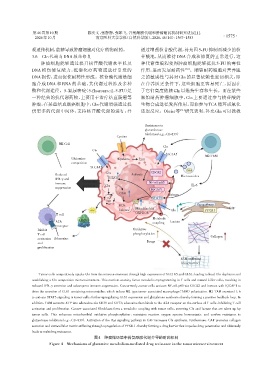
                   Tumor cells competitively uptake Gln from the microenvironment through high expression of SLC1A5 and GLS1,leading to local Gln depletion and
                establishing a Gln competition microenvironment. This nutrient scarcity forces metabolic reprogramming in T cells and natural killer cells,resulting in
                reduced IFN⁃γ secretion and subsequent immune suppression. Concurrently,tumor cells activate NF⁃κB p65 via CDC42 and interact with IQGAP1 to
                drive the secretion of GLS1⁃containing microvesicles,which induce M2⁃type tumor⁃associated macrophage(TAM)polarization. M2⁃TAM secretes IL⁃6
                to activate STAT3 signaling in tumor cells,further upregulating GLS1 expression and glutathione synthesis,thereby forming a positive feedback loop. In
                addition,TAM converts ATP into adenosine via CD39 and CD73;adenosine then binds to the A2A receptor on the surface of T cells,inhibiting T cell
                activation and proliferation. Cancer⁃associated fibroblasts form a metabolic coupling with tumor cells,secreting Gln and lactate that are taken up by
                tumor cells. This enhances mitochondrial oxidative phosphorylation,maintains reactive oxygen species homeostasis,and confers resistance to
                glutaminase inhibitors(e.g.,CB⁃839). Activation of the Ras signaling pathway in CAF increases Gln synthesis. Furthermore,CAF promotes collagen
                secretion and extracellular matrix stiffening through upregulation of PYCR1,thereby forming a drug barrier that impedes drug penetration and ultimately
                leads to multidrug resistance.
                                            图4   肿瘤微环境中谷氨酰胺代谢介导的耐药机制
                        Figure 4  Mechanisms of glutamine metabolism⁃mediated drug resistance in the tumor microenvironment

